 how-to
How to Fluff a Down Jacket After Washing: 7 Steps
Quick Summary
To fluff a down jacket after washing, first check the care label and dry it on low heat or air-dry it, adding clean tennis balls to break up clumps. Shake and hand-separate the filling between rounds, and keep drying until the thickest baffles and seams feel fully dry.
- Check the care label first, because some jackets are air-dry only.
- Use the lowest heat setting and add two to four clean tennis balls or wool dryer balls.
- Run cycles of about 30 to 45 minutes, then shake and check the jacket between each one.
- Judge dryness by squeezing thick baffles and feeling the seams, not the outer shell.
- Heavy parkas may need two or three rounds, or a full day or more when air-drying.
Table of Contents
- Check the Care Label Before You Start
- Why a Down Jacket Clumps After Washing
- How to Dry a Down Jacket in the Dryer on Low Heat
- How Long to Dry a Down Jacket and Why It Takes Several Cycles
- Air-Drying and Signs the Down Is Still Damp
- Troubleshooting Persistent Clumps, Odor or Uneven Filling
- Book a LaundrPro Cleaning for Your Next Down Jacket
- Frequently Asked Questions
Check the Care Label Before You Start
Every down jacket comes with a care label, and that tag is your first guide. Some jackets are safe for the dryer on low heat, while others must be air-dried only. Find the tag before you wash anything, because heat can damage the shell fabric, seams and baffles.
Look for the drying symbols. A square with a circle inside usually means tumble drying is allowed, and a dot inside the circle means low heat. A square with an X through the circle means do not tumble dry. If you cannot find a tag, treat the jacket as air-dry only.
A Simple Decision Tree for Dryer-Safe vs. Air-Dry-Only Jackets
Use the label first, then confirm with the jacket itself. Work through these questions in order:
- What does the care label say? If it shows a tumble-dry symbol, the jacket is a dryer candidate. If it shows the crossed-out circle or says "air dry only," stop here and plan to air-dry.
- What is the shell made of? Tightly woven nylon and polyester shells with a durable water repellent (DWR) finish generally tolerate low heat. Shells with glued seams, laminated membranes, or a rubberized coating are riskier in any heat, so air-dry them unless the label explicitly allows tumble drying.
- How is the jacket constructed? Sewn-through baffles (stitching visible on both sides) dry faster and tolerate tumbling better than box-wall or welded baffles, which hold more down and more water. If the jacket is heavily baffled and thick, expect longer drying and check the core carefully.
- What equipment do you have? A tumble dryer with a low-heat or air-fluff setting and clean dryer balls is the fastest safe route. No dryer? A warm, well-ventilated room with a fan and a sturdy hanger is the air-dry path.
- Is the jacket very old or already damaged? Loose seams, a peeling coating, or a shell that feels brittle point to air-drying to avoid making things worse.
Watch out: Never assume a jacket is dryer-safe because it looks sturdy. A high-heat cycle can melt the coating on some shells and leave the filling scorched or uneven. Also check pockets and closures before drying: remove anything left inside, zip zippers, and close hook-and-loop fasteners so they do not snag the shell or trap clumps of down.
Why a Down Jacket Clumps After Washing
Down clumps when water soaks into the feathers and pulls them together. The filling loses the air pockets that give the jacket its loft, which is why a freshly washed jacket can look flat and lumpy.
Clumping is normal and usually fixable. Most of the problem goes away once the jacket is fully dry and the filling is separated again. The real risk is drying too fast or not at all, which can leave damp feathers that smell musty.
How to Dry a Down Jacket in the Dryer on Low Heat
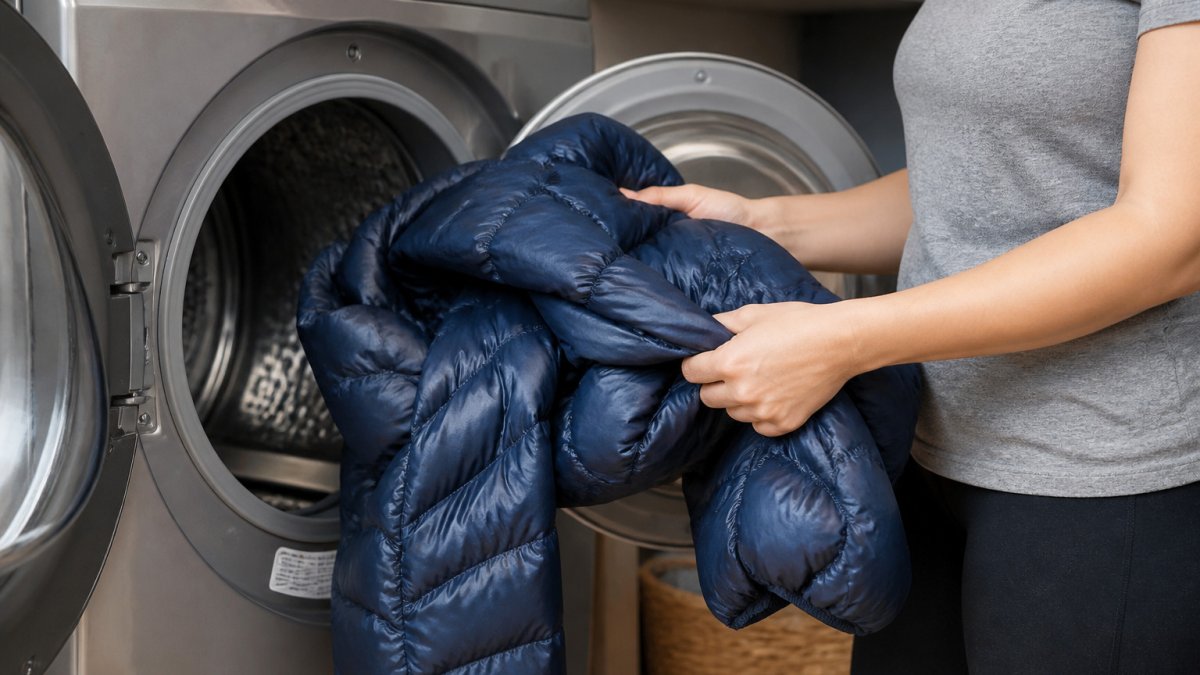
If the care label allows tumble drying, use the lowest heat setting you have. High heat can damage the shell and the down, so low or no heat is the safe choice.
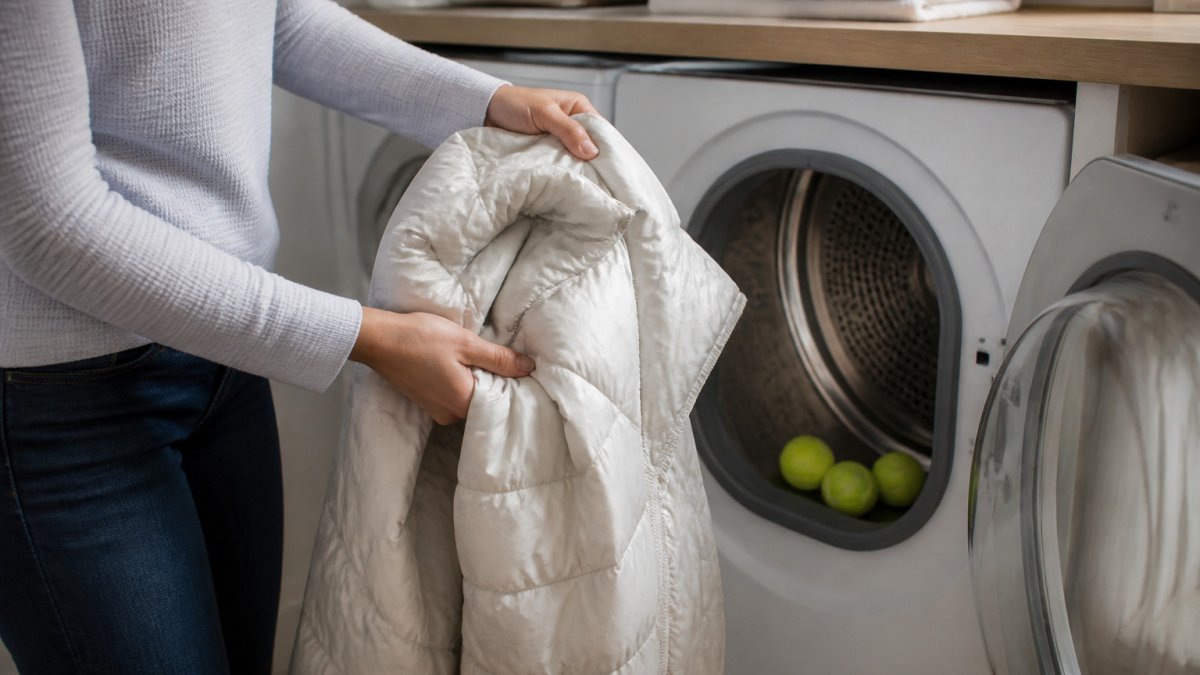
Follow these steps:
- Wring out excess water gently. Press the jacket against the side of the tub rather than twisting it.
- Place the jacket in the dryer alone or with only a few light items.
- Add two to four clean tennis balls or wool dryer balls to bounce the filling apart.
- Run the dryer on low or no heat for about 30 to 45 minutes.
- Stop the cycle, take the jacket out, and check for damp spots or clumps.
Adding Clean Tennis Balls or Dryer Balls
Tennis balls and wool dryer balls tumble with the jacket and help break up clumps as the down dries. Use clean balls only, since dirty ones can leave marks on light-colored fabric.
Breaking Up Clumps by Hand and Shaking
Once the jacket is partly dry, take it out and shake it hard to fluff a down jacket. Hold it by the hem and snap it open, then pat the body and sleeves. This moves the filling back to where it belongs.
Work the clumps with your fingers, especially around the seams and baffles where down tends to gather. Gentle pressure is enough. Pulling or squeezing too hard can tear the shell or open seams.
How Long to Dry a Down Jacket and Why It Takes Several Cycles
Learning how to fluff a down jacket properly often takes several cycles, not just one. Down is dense and holds water deep inside the feathers, so the core can stay damp long after the outside feels dry.
Plan for more time than you expect. A single cycle may be enough for a light jacket, but a heavy parka can need two or three rounds with fluffing in between. Each time you pause, shake the jacket and check the filling again.
The article suggests a rough timeline for drying a down jacket, depending on its weight and the method used.
| Drying method | Typical time | Notes |
|---|---|---|
| Dryer, low heat | 30 to 45 minutes per cycle | Check and fluff between cycles |
| Dryer, heavy parka | Two or three rounds | Fluff between each round |
| Air-drying | A full day or more | Heavy parka in humid climates takes longer |
Air-Drying and Signs the Down Is Still Damp
If the care label says air-dry only, lay the jacket flat on a clean towel or hang it on a sturdy hanger in a warm, airy room. Keep it away from direct heat and sunlight, which can damage the fabric. Flip it every few hours so the bottom layers dry too. A fan pointed at the jacket, or a room with good cross-ventilation, speeds things up without adding heat.
Air-drying is slower than tumble drying, and in humid climates it can take considerably longer. Plan for a full day or more for a heavy parka, and do not rush the process by moving the jacket near a radiator, space heater, or direct sun. For more guidance on fluffing and drying bulky washed items, see the related comforter guide.
Drying Checkpoints: How to Tell the Down Is Fully Dry
Surface feel is not a reliable test. Down holds water deep inside the feathers, so the shell can feel dry while the core is still damp. Use these checkpoints instead:
- The baffle squeeze test. Pinch a thick baffle between your fingers and press firmly. A fully dry baffle feels springy and light. A damp one feels dense, cold, or slightly sticky in the center.
- The seam check. Run your fingers along the seams and the areas where baffles meet. These are the last places to dry and the first places to show dampness. If the seam feels cool or clammy, keep drying.
- The weight test. Compare the jacket's weight to how it felt before washing. A jacket that still feels noticeably heavier than it should is holding water.
- The smell test. A musty or wet-dog smell means damp down, not dirt. Do not add more detergent; add more drying time.
- The clump test. Squeeze a clump gently. A damp clump feels soft and sticky and separates reluctantly. A dry clump feels fluffy and separates easily when you roll it between your fingers.
Damp Clumps vs. Permanent Damage
Not every lump means the jacket is ruined. A damp clump is soft, cool, and sticky, and it loosens when the down dries and is worked apart. Permanent damage looks different: matted down that stays hard and clumped after thorough drying, a musty smell that persists, or a shell that feels stiff or cracked. If the down stays matted after repeated low-heat cycles and hand separation, the filling may have been scorched, contaminated, or compressed beyond easy recovery.
Troubleshooting Persistent Clumps, Odor, or Uneven Filling
Most problems come from incomplete drying or from detergent residue. Use a mild detergent made for down or technical outerwear, and rinse the jacket fully. Leftover soap can weigh down the feathers and cause clumping.
If clumps remain after drying, try another gentle cycle in the dryer with tennis balls, or continue air-drying with periodic shaking and hand separation. For a musty smell, the jacket probably needs more drying time, not more soap.
Troubleshooting Persistent Clumps, Odor or Uneven Filling
Most problems come from incomplete drying or from detergent residue. Use a mild detergent made for down or technical outerwear, and rinse the jacket fully. Leftover soap can weigh down the feathers and cause clumping.
If clumps remain after drying, try another gentle cycle in the dryer with tennis balls. For a musty smell, the jacket probably needs more drying time, not more soap. For uneven filling, shake the jacket hard and work the down toward the empty areas by hand.
Book a LaundrPro Cleaning for Your Next Down Jacket
Drying a down jacket takes patience, and it is easy to get wrong at home. If you would rather not handle it yourself, LaundrPro offers door-to-door laundry and dry cleaning service in Miami. Pricing depends on quantity, dates, and delivery, so visit the LaundrPro website for current prices or a quote. If you are in Westchester, you can check pickup and delivery coverage for your address.
Frequently Asked Questions
How do you break up clumps in a down jacket after washing?
Clumps usually form when wet down bunches together in the baffles. Gently shake the jacket and pat the sections by hand to loosen the filling, then work any stubborn lumps apart with your fingers, moving from the outside of the clump toward the center. Do this while the jacket is still slightly damp so the down separates more easily. Dryer balls or clean tennis balls tossed in on low heat help break up remaining clumps as the jacket dries, and you should repeat the shaking between drying cycles until the filling spreads evenly.
Can you put a down jacket in the dryer?
Many down jackets can go in the dryer, but only if the care label permits tumble drying and only on low or no heat. High heat can scorch the down, damage the shell fabric and seams, and leave the jacket less lofty. Use the lowest setting, add clean tennis balls or dryer balls, and check the jacket every cycle. If the label says dry clean only or line dry, skip the dryer and air-dry the jacket flat or hung on a sturdy hanger instead.
How long does it take for a down jacket to dry completely?
Drying a down jacket often takes several cycles or many hours, depending on the thickness of the fill and the humidity around it. In a dryer on low heat, expect multiple cycles with shaking in between. Air-drying can take a day or longer. Confirm the jacket is fully dry by squeezing the baffles and checking the center of the fill, since damp down can feel dry on the outside while still holding moisture inside. Putting a damp jacket away can lead to mildew and odor.
Is a down jacket ruined if it gets wet?
No, a down jacket is not ruined by getting wet. Down loses insulating loft when it is wet, but it recovers once it dries completely. The risk comes from storing it damp, which can cause odor or mildew, so dry it fully before storing. If the jacket was soaked, wash it on a gentle cycle with a down-specific detergent, then dry it using the low-heat dryer method with tennis balls and repeated shaking.