 ultimate-guide
Why Laundry Takes So Long for Large Households
Table of Contents
- The Reality of Laundry Time vs. Perceived Time in Large Households
- Average Laundry Time Per Load: What the Numbers Actually Look Like
- Why Modern Washing Machine Cycles Take Longer Than You Expect
- How Water Pressure and Inlet Valve Issues Slow Every Wash Cycle
- How to Break Up Laundry Throughout the Week Without Burning Out
- The Difference Between Wash Time and Hands-On Time
- How to Fold Clothes Properly and Cut Your Folding Time in Half
- When to Hand Off Bulk Laundry to a Laundry Service in Miami
- Frequently Asked Questions
Last Updated: September 10, 2026
The Reality of Laundry Time vs. Perceived Time in Large Households
Ask any parent of three or more kids how long laundry takes, and you'll get a sigh before an answer. The reason why laundry takes so long for large households isn't one problem, it's a stack of them: sheer volume, longer modern wash cycles, slow fills, and the folding marathon at the end. At LaundrPro, we pick up and deliver laundry across Miami, and families rarely underestimate the washing, they underestimate the handling.
Laundry time is the total elapsed time a load occupies your machine and your attention, from sorting through folding. For a family of five, that runs several times higher than a single person's weekly total, driven by load capacity, load frequency, cycle duration, and hands-on time.
Average Laundry Time Per Load: What the Numbers Actually Look Like
A single wash cycle in a modern top-load machine typically runs 45 to 90 minutes, and a dryer adds another 45 to 75 minutes (energy.gov). That's elapsed machine time, not your time. The average laundry time per load for a large household stretches further because bulky items like comforters and bed sheets often need a second rinse or a longer dry.
Load frequency is where the math turns ugly:
| Household Size | Loads Per Week (typical) | Weekly Machine Hours | Weekly Hands-On Time |
|---|---|---|---|
| 1-2 people | 3-4 | 5-7 | 1-2 hours |
| 3-4 people | 6-8 | 10-14 | 3-4 hours |
| 5-6 people | 9-12 | 15-21 | 5-7 hours |
| 7+ people | 13-18 | 22-30 | 8-10 hours |
The machine hours are the easy part. The hands-on column is what drains a Saturday.
Why Modern Washing Machine Cycles Take Longer Than You Expect
Today's machines trade speed for efficiency, and that trade is deliberate. Federal energy standards pushed manufacturers toward high-efficiency designs that use less water and less hot water, meaning longer agitation, longer rinses, and slower spins. A "normal" cycle can run well past an hour.
Cycle duration is also a function of load balancing. An unbalanced drum forces the machine to redistribute the load and restart the spin, adding 10 to 20 minutes per interruption. Overloading to "save a load" backfires, comforters especially need room to tumble.
How Water Pressure and Inlet Valve Issues Slow Every Wash Cycle
Low water pressure is the silent time thief in older homes, and Miami's housing stock includes plenty of them. When supply pressure drops, the inlet valve takes longer to fill the drum, and every fill stage stretches. A wash with three or four fill stages can gain 15 to 30 minutes without any error code appearing.
The U.S. Department of Energy guidance on appliance efficiency notes that water and energy use are tied directly to how a machine fills and rinses. A partially clogged inlet screen, a failing inlet valve, or a supply line shared with a running irrigation system all reduce fill rate. Check the inlet screens twice a year. If your machine takes noticeably longer to fill than it used to, the valve is the first suspect, not the control board.
How to Break Up Laundry Throughout the Week Without Burning Out
Most guides tell large households to "spread laundry across the week" and stop there. That advice fails because it ignores the two forces that make a schedule stick: workflow logistics (who touches which pile, and when) and Miami's climate (how fast wet clothes turn into a mildew problem).
Why the weekend marathon fails in a large household
A family of six generates roughly 9 to 12 loads a week. Stacked into Saturday, that's 15 to 21 machine hours and 5 to 7 hours of hands-on time competing with every other weekend obligation. The pile also compounds: in Miami's year-round humidity, often 70% to 80% indoors without A/C, a forgotten load can develop that musty odor in as little as 8 to 12 hours. Once mildew sets in, you're re-washing, adding a full cycle back to your week.
Spreading loads shortens each session, keeps wet fabric moving to the dryer faster, and prevents the re-wash penalty that adds 1 to 3 extra loads per week in humid climates.
Build the schedule around logistics, not days
The day-by-day plan matters less than the stations you set up:
- Color-coded hampers, one per person. Whites, darks, and delicates get sorted at the source, not on laundry day. This alone removes 10 to 15 minutes of sorting per load.
- A dedicated "drop zone" next to the machine. One basket for incoming dirty, one for clean-but-unfolded, one for outgoing-to-rooms. No piles on the floor, no lost socks under the machine.
- A fixed wash window each day. Pick a time you're already home, before dinner, after school pickup, and start one load. The machine runs while you cook or help with homework.
- A rotating assignment. Older kids own their hamper-to-drawer cycle. Younger kids handle towels and socks. Adults handle delicates, work clothes, and bulk items.
A sample week that respects both the climate and the calendar:
- Monday: Towels, hot water, dry immediately. Towels are the worst mildew offenders in Miami.
- Tuesday: Kids' everyday clothes, cold water, quick cycle.
- Wednesday: Bed sheets for two bedrooms, rotated weekly.
- Thursday: Adult work clothes, hung or laid flat within 15 minutes of the dryer stopping.
- Friday: One bulk load, comforters or blankets on rotation. Start it in the morning so it has all day to dry.
- Saturday: Catch-up load only. Nothing else.
- Sunday: Off.
The Miami-specific rule that changes everything
In most of the country, a forgotten load is an inconvenience. In Miami, it's a re-wash. The practical rule for large households here is simple: never let wet fabric sit more than a couple of hours, and never leave a load in the washer overnight. If you can't move a load to the dryer in that window, use a delay-start so it finishes when you're available, or a washer with a fresh-hold feature that tumbles the drum periodically. A front-loader with the door left ajar also dries out faster than a closed top-loader.
What to do when the schedule still breaks
Even a good system fails during school start, a work crunch, a new baby, or a heat wave that doubles daily clothing turnover. Don't try to "catch up" with a marathon, that's how loads get overloaded and cycles extended. Instead, triage: run only what's needed for the next 48 hours, and hand off the bulk backlog (comforters, bed sheets, towels) to a service that can process it in parallel with your daily routine.
The Difference Between Wash Time and Hands-On Time
Wash time is what the machine does. Hands-on time is what you do, and it determines whether laundry feels like a chore or a crisis. Sorting, pretreating, moving loads, hanging, folding, and putting away all count, and none of it happens while you're doing something else.
For a large household, hands-on time typically runs 30 to 45 minutes per load once you include folding and distribution to bedrooms. Ten loads a week means five to seven hours of your attention. That's the real answer to why laundry takes so long for large households: the machine isn't the bottleneck. You are.
Reducing hands-on time is the highest-use move available. Batch folding in front of a screen, assign each family member their own basket, and stop matching socks entirely.
How to Fold Clothes Properly and Cut Your Folding Time in Half
Folding gets blamed for laundry feeling endless, but in a large household the bigger hidden time sink is appliance maintenance. A washer quietly running 15 to 25 minutes longer per cycle because of a clogged filter or confused sensor adds 2 to 4 hours of machine time per week, before anyone folds a single shirt. Fix the machine first, then fix the fold.
The maintenance issues that silently extend every cycle
Heavy-use households, 9 or more loads a week, hit maintenance thresholds single-person homes never reach. The three most common culprits:
- Clogged lint filter and drain pump filter. Front-loaders have a small access panel near the bottom with a filter that traps coins, hair, and lint. When it clogs, the machine can't drain efficiently, so it adds drain-and-spin cycles. Most manufacturers recommend checking it monthly in high-use homes. A five-minute clean can shave 10 to 20 minutes off every subsequent load.
- Dirty or overloaded moisture sensors. Dryers use moisture-sensing bars inside the drum to decide when clothes are dry. Fabric softener residue and lint film coat those bars, so the dryer keeps running because it thinks clothes are still damp. Wipe the sensor bars with a damp cloth and a little rubbing alcohol every few weeks. In a large household, this alone can cut 10 to 15 minutes off each dry cycle.
- Washer load-sensing errors. High-efficiency washers weigh or sense the load to set water level and cycle length. If you consistently overload, the sensor recalibrates and the machine defaults to longer cycles. Running two medium loads instead of one stuffed load keeps the sensor honest.
A folding method built for volume, not for one shirt
The goal of folding in a large household isn't a perfect fold, it's a fold that survives the drawer so you never touch the same shirt twice. The method that saves the most time:
- Sort by owner, not by garment type. Each person gets one basket, start to finish. Context switching is what slows folding down, not the folding itself.
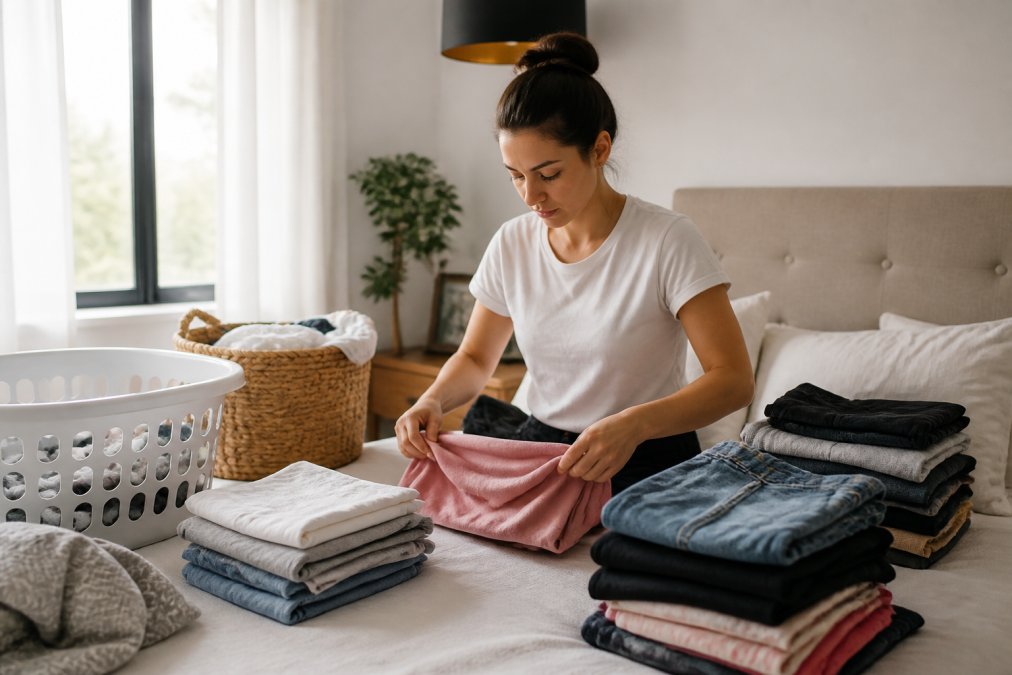
- Fold shirts in three moves. Lay flat, fold both sleeves inward, fold in half once.
- File-fold instead of stacking. Fold into a rectangle and stand it upright in the drawer. You can see everything at a glance, and nothing gets crushed at the bottom of a stack.
- Skip folding what doesn't wrinkle. Underwear, socks, pajamas, and towels go straight into the drawer or basket. This one rule can cut folding time by a third.
- Fold standing up at counter height. It's faster than folding on a bed, and easier on your back during a multi-basket session.
A common mistake is folding straight out of the dryer one item at a time. Pull the whole load, sort into owner piles, then fold each pile in one pass.
The workflow that actually shrinks hands-on time
Folding is only one slice of hands-on time. Sorting, pretreating, moving loads, hanging, folding, and distributing to bedrooms all count. For a large household, hands-on time typically runs 30 to 45 minutes per load once folding and distribution are included, and 10 loads a week means 5 to 7 hours of your attention.
The highest-leverage fixes are structural, not motivational:
- Color-coded hampers eliminate sorting at the machine.
- One basket per person eliminates distribution guesswork.
- A "clean but unfolded" bin lets you defer folding to a batch session instead of doing it load by load.
- A no-sock-matching rule removes one of the most time-consuming micro-tasks in family laundry.
When the weekly pile outgrows what your machine, schedule, or patience can absorb, the answer isn't a better fold, it's moving bulk items off your plate. Comforters, bed sheets, and towels take the longest to dry and fold, and they're the easiest to hand off to a pickup-and-delivery service so your home machine stays focused on daily wear.
When to Hand Off Bulk Laundry to a Laundry Service in Miami
There's a point where the routine stops working, and for most large households it arrives during a busy season, not permanently: school starting, a work crunch, a new baby, houseguests, or a heat wave that doubles daily clothing turnover. That's when a laundry service Miami families can rely on earns its place.
Miami's climate makes this sharper than most cities. Year-round humidity slows drying, and running a dryer longer in an already hot home pushes energy consumption up. Comforters and bed sheets are the worst offenders: they take the longest to dry, and most home machines handle them poorly without shrinking or uneven drying.
Handing off bulk laundry makes sense when:
- Your weekly load count exceeds what a single weekend can absorb.
- Bulky items are piling up faster than you can rotate them.
- Work clothes need a consistent 24-48 hour turnaround you can't guarantee yourself.
- You want the folding and distribution handled, not just the washing.
LaundrPro picks up and delivers door to door across Miami, handles bulky items like comforters and bed sheets, and works on flat-rate pricing with no subscriptions and no hidden fees. Pricing depends on your volume and turnaround, so check the LaundrPro pricing page for current rates. If you've been burned by missed pickups from app-based services, a local operation can offer a different experience.
U.S. Environmental Protection Agency information on residential water use is a useful reference if you want to see how much water laundry actually consumes in a high-volume household.
Large households don't have a laundry problem, they have a throughput problem, and no amount of clever folding fixes a system already at capacity. When the weekly pile outgrows your machine, schedule, or patience, that's the moment to move bulk laundry off your plate. LaundrPro offers door-to-door pickup and delivery, flat-rate pricing with no subscriptions or hidden fees, and fast turnaround on everything from daily wear to comforters and delicate garments. Place your order with LaundrPro.
Frequently Asked Questions
Why is my washer taking 2 hours to wash?
Modern high-efficiency washers often run 60 to 120 minutes because they use less water and rely on longer tumble and soak phases to clean clothes. If your washer is taking closer to 2 hours, check whether you selected a heavy-duty or sanitize cycle, which adds time. Also inspect the inlet valve and water pressure; restricted flow makes the machine wait longer to fill. Running smaller loads on a normal cycle usually cuts cycle duration significantly.
How do large families handle laundry without losing their weekends?
Most large households assign each person a laundry day, run one load per day instead of a marathon, and keep a dedicated sorting station. They also fold clothes immediately after drying to avoid pileup. For bulky items like comforters and bed sheets, many families use a pickup laundry service Miami offers to handle the heavy loads. This keeps the household laundry routine manageable and frees up weekend time.
Is it normal for a washing machine to take 4 hours?
A 4-hour wash is not normal for a standard cycle. It usually points to a restricted water inlet valve, low water pressure, or a machine stuck in a pre-soak or steam-refresh setting. In humid climates, some dryers also take longer, but the washer itself should not run 4 hours. Check your manual for expected cycle times, clean the inlet screens, and if the problem continues, have a technician inspect the valve and pressure switch.
Why is my dryer taking 2 hours to dry clothes in humid climates?
High humidity slows evaporation, so a dryer works harder to pull moisture from fabric. A clogged lint trap or blocked vent hose makes it worse by trapping moist air. Clean the lint trap after every load, inspect the vent hose for kinks, and consider running the dryer during cooler parts of the day. For large households, drying in smaller batches and using moisture sensors helps cut drying time and energy consumption.