 how-to
How to Organize a Laundry Room for a Busy Family
Quick Summary
Laundry room organization for families starts with a short audit of what is stored there and how many loads your household runs each week. Then set up three zones for dropping, supplies and folding, using vertical storage and simple labeled bins. Keep airflow in mind so the room can dry out between loads.
- Spend about 30 minutes emptying and sorting every shelf, cabinet and drawer before buying anything.
- Count how many loads your household runs each week, since your own count matters more than averages.
- Use three bins for lights, darks and towels, labeled with words so everyone sorts the same way.
- Assign laundry roles by age, keeping detergent locked or high because pods pose a poisoning risk to young children.
- Run one load each weekday evening and two or three on Saturday to keep the backlog from growing.
Table of Contents
- Start With a Laundry Room Audit: What You Have and What It Needs
- Set Up a Small Laundry Room Organization for Families
- Build a Sorting System That Holds Up Under Volume
- Create a Laundry System for a Large Family
- Lay Out a Daily Laundry Schedule for a Family
- Laundry Room Organization DIY Projects You Can Finish in a Weekend
- Keep the System Running and Book Pro Help When You Need It
- Frequently Asked Questions
How to Organize a Laundry Room for a Busy Family
Last Updated: November 6, 2026
Start With a Laundry Room Audit: What You Have and What It Needs
Laundry room organization for families starts with one honest question: what is actually in the room right now? Most families store far more than they use, and the clutter quietly slows every load. A short audit shows you what to keep, what to move, and what to remove.
Here is how to run one in about 30 minutes:
- Empty every shelf, cabinet and drawer onto the floor or a table
- Sort items into keep, move, donate and trash piles
- Count how many loads your household runs each week
- Note where dirty clothes actually land, such as the floor or a chair
- Measure the wall space above the washer and dryer
Watch out: a laundry room that looks tidy can still hide a backlog. Check the hamper and the floor corner before you call the audit done.
According to the American Cleaning Institute (2026), 43% of U.S. households do one to three loads of laundry per week. American Cleaning Institute National Laundry Day survey Your own count matters more than any average, because a family of five needs a different setup than a couple.
Once you know your load count and your space, you can plan the rest of the room. Our first step is always to match storage to real habits, not ideal ones.
Set Up a Small Laundry Room Organization for Families
Small laundry rooms need vertical thinking, but they also need a layout that matches the shape of the room. A laundry closet off a Miami hallway, a condo utility alcove, and a townhome laundry nook each fail in different ways, so measure before you buy.
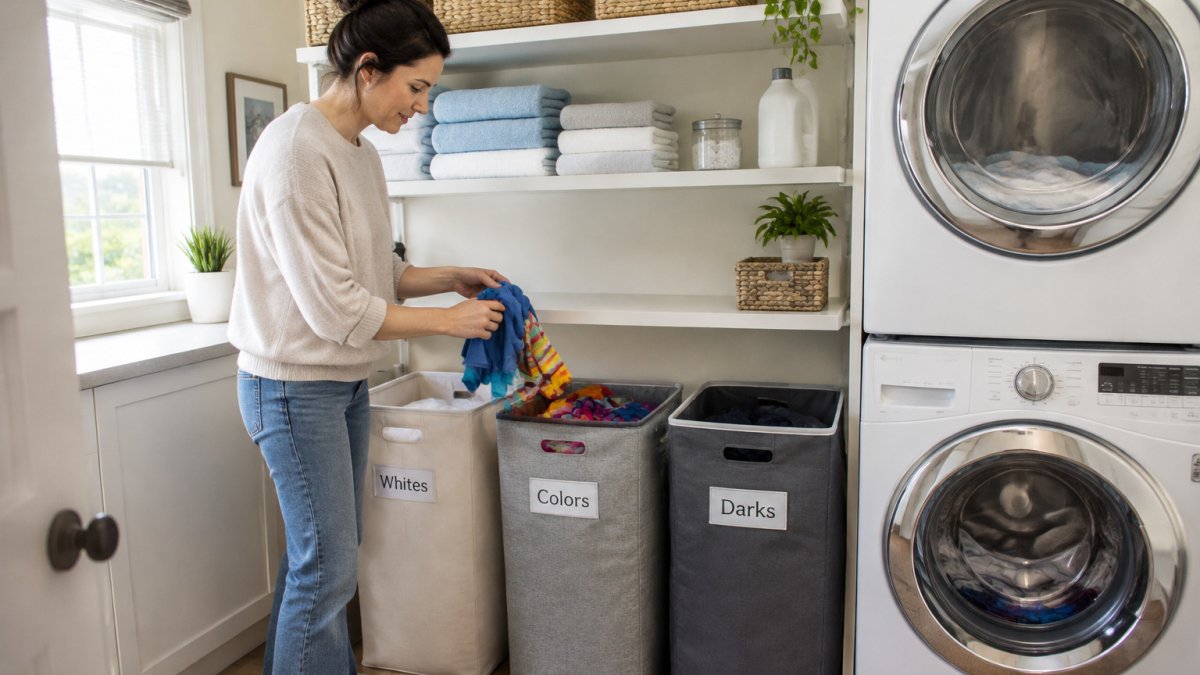
Start by mapping the three zones every compact family laundry room needs:
- The drop zone, where dirty clothes land the moment they come off. In a closet, this is usually a narrow rolling hamper that fits beside the machine; in a condo alcove, it may be a wall-mounted bag on the door.
- The supply zone, detergent, stain treatment, and dryer sheets. Keep these above adult shoulder height or in a locked cabinet, never on the floor where toddlers and pets can reach them.
- The fold-and-stage zone, a surface where clothes can be folded or laid flat to dry. If floor space is gone, a wall-mounted fold-down table that stows flat against the wall is the standard fix.
Measure the wall above the washer and dryer before you shop. Measure the width of your machines and the depth of the shelf you plan to use so the shelf clears the top of the machines and leaves room for bottles.
For a laundry closet, the highest-value moves are usually:
- A shelf or rail above the machines for detergent and supplies
- A pegboard or wall bin on the side wall for lint rollers, stain sticks, and brushes
- An over-the-door rack for drying items or holding a second hamper
- One open bin per family member, stacked vertically if floor space is tight
For a condo or apartment utility alcove, renters should lean on no-drill options: tension rods, freestanding carts on casters, over-the-door racks, and stackable bins. These leave no permanent marks and can move with you.
Watch out: stacking heavy bottles on a high shelf above the machines can be dangerous when kids are nearby, and in a humid room the bottles also collect condensation. Keep detergent and cleaners on a locked or high shelf, away from young children, and wipe down shelves monthly.
Humidity is the factor most organization guides skip. In a Miami laundry closet or garage-adjacent utility room, damp air and a closed door create the conditions for mildew on towels, hampers, and the wall behind the machines. Run the dryer vent fully outside, keep the door open after a load, and consider a small dehumidifier or a vented door if the room has no window.
Vertical storage is still the quickest win for compact rooms, but pair it with airflow. A shelf that frees floor space is only useful if the room can dry out between loads.
Build a Sorting System That Holds Up Under Volume
A good sorting system works when the hamper is full. Most laundry backlogs happen because sorting takes too many steps, so keep the system simple.
- Use three bins: lights, darks and towels or heavy items
- Put one bin in each bedroom or near the bathroom for easy drop-off
- Add a separate bin for delicates and anything that needs special care
- Label each bin with a word, not just a color, so everyone sorts the same way
Sorting at the source saves time later. When each person drops clothes into the right bin, the laundry room does not need a second sorting session. This matters most when your daily laundry volume is high.
Create a Laundry System for a Large Family
A large family needs a system that runs without one person doing everything, and the system has to match what each family member can safely do. Assign roles by age and ability, write them on a chart near the machines, and revisit the chart as kids grow.
A workable split for a family of five or more:
| Task | Who Does It | How Often |
|---|---|---|
| Collect dirty clothes from bedrooms and bathrooms | Each family member | Daily |
| Carry hampers to the laundry room | Kids ages 8 and up | Daily or as needed |
| Sort into lights, darks, and towels | Kids ages 6 and up with labels | Daily |
| Load washer and add detergent | Parent or teen | Daily or every other day |
| Move clothes to dryer or drying rack | Teen | Daily |
| Fold and put away | Rotating family members | Daily |
| Restock supplies and wipe surfaces | One adult | Weekly |
Age matters more than most charts admit. School-age kids can sort by labeled bin and carry a small hamper, but keep detergent pods and bottles locked or on a high shelf, pods look like candy and are a known poisoning risk for young children (the CDC).
Make the labels do the work. Use a word plus a color on each bin, for example, 'Lights, yellow' and 'Darks, navy', so a child who cannot yet read the full word can still match the color.
Plan for more loads than you think you need. A household of five or more often runs an extra load a day during sports seasons, school weeks, and the humid summer months when towels and workout clothes pile up faster.
Keep a small supply caddy with stain treatment, a lint roller, and a spare dryer sheet in the room so a single person is not the only one who knows where things are. When the system depends on one person's memory, it collapses the first busy week.
Watch out: a chart that assigns all folding to one person creates resentment and a permanent backlog. Rotate the folding role weekly, and let each family member fold and put away their own clothes once they are old enough to do it.
Finally, tie the roles to the room layout. If the bins live in bedrooms, the collection role is a short trip. If the only sorting space is in the laundry room, the sorting role belongs to whoever is already in there.
Lay Out a Daily Laundry Schedule for a Family
A daily laundry schedule keeps the backlog from growing. You do not need a perfect plan, just a repeatable one.
- Monday to Friday: run one load each evening
- Saturday: run two or three loads for towels, bedding and heavy items
- Sunday: fold, put away and reset the bins
Adjust the schedule to your week. If one evening always gets busy, move that load to the morning. Consistency matters more than the exact days.
Laundry Room Organization DIY Projects You Can Finish in a Weekend
Most of these projects need only basic tools and a few hours. Pick one or two for the first weekend.
- Install a wall-mounted fold-down table to create a folding station
- Hang a clothes rod on the back of the door for drying delicates
- Build or buy open cubbies for each family member's bin
- Add a pegboard above the counter for supplies and small tools
Measure twice before you drill, and check for hidden wires or pipes in the wall. Anchor shelves into studs when you can, especially in rooms with heavy machines.
Many renters can do these projects too. Use tension rods, freestanding carts and over-the-door racks that leave no permanent marks.
Keep the System Running and Book Pro Help When You Need It
Review your laundry room every month. Check whether the bins still fit your load count and whether anything has drifted back into the wrong place. Small adjustments keep the system working.
If the volume becomes too much to manage yourself, a wash-and-fold service can take some of the load off your week. Recogida y entrega de lavandería en Miami lets you check local pickup and delivery coverage online. Wash & Fold Laundry in Miami offers pickup and delivery in eligible areas, with pricing based on weight. You can also explore Miami laundry care tips for more guides on handling a busy household's laundry.
Organizing a laundry room for a busy family comes down to three things: a clear audit, a sorting system everyone can follow, and a schedule you will actually keep. Start with one change this week, and build from there.
Frequently Asked Questions
What are the best laundry room organization ideas for a small space?
In a small laundry room, go vertical first. Mount shelves above the machines, add a pegboard or rail for drying racks and hang a rod for quick-dry items. Put a rolling cart or a tall hamper beside the washer so sorting happens where the clothes start. Over-the-door bins hold detergent and stain treatment without taking floor space. Keep only the supplies you use weekly within reach and store backups higher up. Label every bin so family members can put things away without asking where they go.
How should a family sort and store laundry?
Sort into at least three groups: lights, darks and delicates, with a fourth bin for towels and linens if volume is high. Give each family member a labeled hamper so dirty clothes are sorted by owner from the start. Store the sorting bins near the washer, and keep folded clean clothes in baskets on a counter or shelf near the folding area. Assign each person a basket for clean clothes so put-away is simple and nothing ends up piled on a chair.
What is a good daily laundry schedule for a family of six?
Run one or two loads each weekday and handle larger jobs such as bedding and towels on the weekend. A common pattern is washing on Monday, Wednesday and Friday, drying and folding the same day, and reserving Saturday for sheets and comforters. Assign one person to check the dryer and fold within an hour of the cycle ending. Adjust the schedule to your school and work calendar, and treat it as a starting point you refine after two or three weeks.
Can I organize a laundry room myself without a big budget?
Yes. Most upgrades use inexpensive parts: adjustable shelving, clear bins, command hooks, a tension rod for hanging drying racks and a plastic over-the-door organizer. Start by clearing the floor and sorting what you own, then add storage in the order you use it. Painting the walls or adding a light can make the room feel organized. Check your local hardware store for basic supplies before buying specialized systems. If you need help with heavy loads or bulky items, LaundrPro offers door-to-door pickup and delivery, and you can request current pricing on the LaundrPro website.