 comparison
Is Professional Laundry Worth It? A Cost & Time Analysis
Table of Contents
- Is Professional Laundry Worth It? The Real Trade-Offs
- Professional Laundry vs. Home Washing: What Changes
- Benefits of Professional Laundry Service for Your Household
- Wash and Fold Service Cost: Pricing Models Explained
- Decision Matrix: When Professional Laundry Makes Financial Sense
- The Hidden Environmental Cost of Professional Laundry
- Reliability and Peace of Mind: The Psychological ROI
- Conclusion: Is It Worth It for You?
Last Updated: August 4, 2026
Is Professional Laundry Worth It? The Real Trade-Offs
When you ask "is professional laundry worth it," you're really asking whether outsourcing this household chore makes financial and lifestyle sense for your situation. At LaundrPro, we've worked with busy individuals and families to understand exactly when this investment pays off and when it doesn't. The answer isn't universal, it depends on your household size, fabric types, work schedule, and how much your time is actually worth to you.
The core question breaks down into three parts: the money, the time, and the wear on your clothes. Most people focus only on the money and miss the bigger picture. You might save money doing laundry yourself, but if you're spending five hours a week on it when you could be earning income or with your family, the math changes entirely.
Professional Laundry vs. Home Washing: What Changes
Professional laundry operations use industrial-grade equipment that fundamentally differs from home washers. The difference isn't just scale, it's the entire approach to garment care.
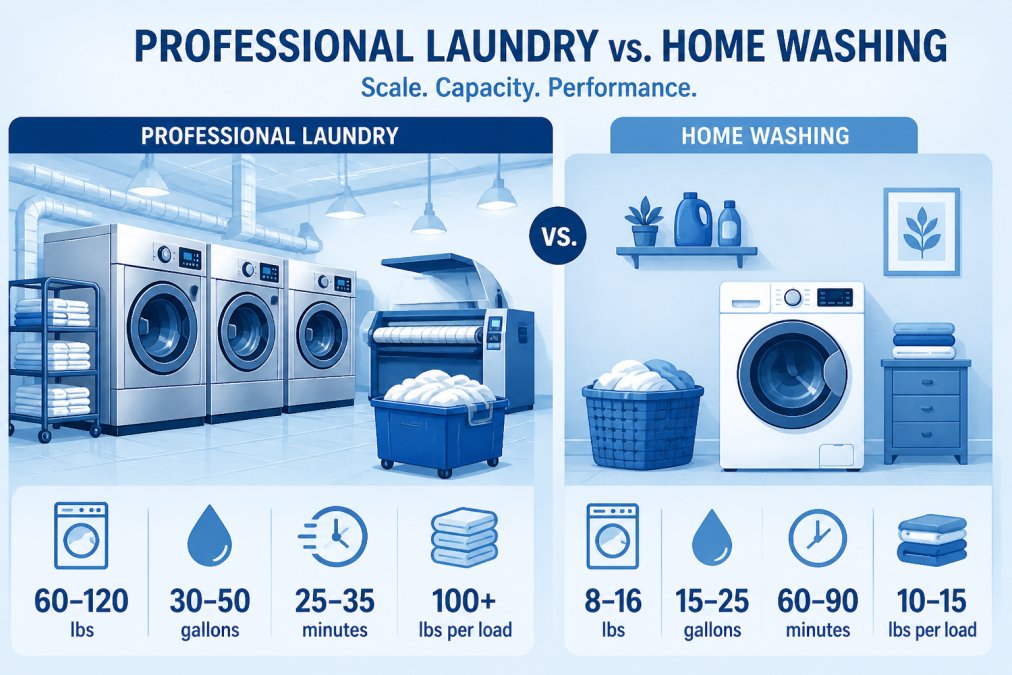
Equipment and Water Efficiency
Industrial washing machines operate at temperatures and spin cycles that home equipment cannot match. Professional facilities use commercial-grade detergents formulated for hard water and heavy soil loads, while home detergents are designed for lighter residential use. The water efficiency story is interesting: while professional laundry uses more water per load in absolute terms, the per-garment water consumption is often lower because the equipment handles 50-100 pounds of fabric in a single cycle versus your home washer's 10-15 pound capacity.
A professional laundry facility can wash, dry, and fold a full week's worth of clothing in a single afternoon. Your home washer requires multiple cycles spread across days. The industrial dryers reach higher temperatures more evenly, which means faster drying and fewer wrinkles, but also requires more precise handling for delicate fabrics.
Detergent Quality and Stain Removal
Professional laundry services use industrial-strength detergents and specialized stain removal treatments that aren't available for home use. When you bring in a garment with a stubborn stain, the facility can apply targeted pre-treatment, let it sit for specific periods, and use enzymatic treatments that break down protein, oil, and tannin stains at a molecular level.
Home stain removal relies on consumer-grade products and guesswork about timing. You might treat a coffee stain and wash it immediately, not realizing that heat sets the stain permanently. Professional handlers know which stains need cold water, which need hot, which need oxidizing agents, and which need enzymes. This expertise prevents the common mistake of making stains permanent through incorrect treatment.
The detergent itself matters. Professional facilities use surfactants that lift soil without requiring excessive agitation, which reduces fiber damage. Your home detergent has to work harder because your machine's action is less efficient, so it requires higher concentrations and more aggressive washing cycles.
Benefits of Professional Laundry Service for Your Household
Understanding the real benefits goes beyond "someone else does the work." It's about what actually changes in your life and your clothing.
Time Savings and Lifestyle Impact
The time calculation is straightforward but often underestimated. A household of four generates roughly 8-10 loads per week. Washing, drying, folding, and putting away takes approximately 45 minutes per load when you account for transfer time between machines, folding, and sorting. That's 6-7 hours per week minimum, roughly 350 hours per year.
For professionals earning $25 per hour or more, outsourcing laundry at any reasonable service cost makes financial sense just on hourly wages. For families with two working parents, this time recaptures weekend hours that could go toward family activities, exercise, or rest. The psychological benefit of not having laundry as a constant background task is real, even if it's not easy to quantify.
Professionals in Miami's service area often work irregular schedules. If you work 10 AM to 8 PM or have variable shift work, finding time to do laundry becomes genuinely difficult. Professional laundry with pickup and delivery means your clothes are handled on a schedule that works for you, not the other way around.
Garment Longevity and Fabric Care
Repeated home washing degrades fabrics faster than professional laundering, assuming the professional service is competent. Home washers use more aggressive agitation, higher temperatures for most loads, and longer spin cycles than necessary. This breaks down fabric fibers over time, causing pilling, stretching, and color fading.
Professional facilities sort by fabric type, not just color. Delicate fabrics get different water temperatures, shorter wash times, and gentler extraction. Sturdy cotton gets more aggressive treatment. Your home washer uses one cycle for everything or requires you to run multiple separate loads, which is time-consuming and often skipped.
A work blazer can last longer with professional care than with home washing. A set of quality sheets maintains its softness and appearance for years longer when handled professionally. The fabric preservation benefit compounds over time, the longer your clothes last, the fewer replacements you need to buy.
Sanitization and Allergy Relief
Professional laundry reaches temperatures and uses sanitization methods that home equipment cannot. Industrial dryers reach 180-200°F consistently, which kills dust mites, bacteria, and allergens. Home dryers typically max out at 140-160°F and don't maintain temperature evenly.
For households with asthma, eczema, or dust mite allergies, professional laundry can genuinely improve health outcomes. The combination of high-temperature washing, industrial-strength detergents, and proper drying creates a sanitization level that home washing cannot match. Families who've switched to professional laundry report fewer allergy symptoms, particularly when bedding is handled professionally.
Professional facilities also separate loads by soil level and fabric type, which means your everyday clothes aren't being washed with heavily soiled items. Your home washer mixes everything together, spreading bacteria and allergens across all garments.
Wash and Fold Service Cost: Pricing Models Explained
Understanding how professional laundry pricing works helps you evaluate whether it's worth it for your specific situation.
Flat-Rate vs. Subscription vs. Per-Load Pricing
Different service models create different cost structures. LaundrPro uses flat-rate pricing with no subscriptions or hidden fees, you pay a transparent rate based on your load and service type, with no surprise charges for delicate items or rush service. This approach appeals to customers who want predictability and distrust subscription models that auto-renew or require contracts.
Other services use per-pound pricing, which can range from $0.50 to $1.50 per pound depending on location and service level. Subscription models typically charge a flat monthly fee ($50-$150) for unlimited or set-quantity pickups, which works well if your laundry volume is consistent.
Per-load pricing favors households with variable laundry volumes. Subscription pricing favors consistent, high-volume users. Flat-rate pricing removes the guesswork entirely, you know exactly what you'll pay before you order.
Hidden Costs to Watch For
Many laundry services charge additional fees that aren't immediately obvious. Rush service often costs more. Delicate item handling can add to the cost. Stain removal treatments are frequently billed separately. Some services charge for pickup and delivery based on distance or frequency.
The worst services have "seasonal pricing", rates jump during busy seasons like back-to-school or holidays. Others charge minimum order fees or require a certain number of pickups per month. Read the fine print carefully, because these hidden costs can double your actual expense.
Transparent services like LaundrPro publish their pricing upfront with no surprises. If you're comparing services, ask specifically: Is there a delivery fee? Do delicate items cost more? Is rush service available and at what price? Are there minimum order requirements? The service that answers these questions clearly is likely the one you should trust.
Decision Matrix: When Professional Laundry Makes Financial Sense
Not every household benefits equally from professional laundry. Your decision should be based on specific factors about your situation.

Household Size and Load Volume
A single person generates 1-2 loads per week. Professional laundry costs more per load than a household of six generating 10-12 loads weekly. Economies of scale matter, the service's fixed costs (delivery, handling, administration) get spread across more garments.
For a single person, professional laundry makes sense only if you're earning high hourly income and have minimal time availability. For a family of four or more, the time savings alone often justify the cost. A family of six with two working parents and children in school generates so much laundry that outsourcing becomes almost necessary for sanity.
| Household Size | Weekly Loads | Time Investment | Professional Worth? |
|---|---|---|---|
| 1 person | 1-2 | 1-2 hours | Only if high-income |
| 2 people | 3-4 | 2-3 hours | Maybe, if both work |
| 4 people | 8-10 | 6-7 hours | Usually yes |
| 6+ people | 12-15 | 9-11 hours | Almost always yes |
Fabric Types and Special Care Needs
If your wardrobe consists mostly of casual cotton and polyester, home washing is adequate. If you own delicate silks, wool sweaters, linen items, or tailored clothing that requires special handling, professional laundry protects your investment.
People who work in professional environments (law, finance, medicine, sales) often own expensive dress clothes that justify professional care. A lawyer with suits and dress shirts has thousands of dollars in clothing that degrades faster with home washing. The fabric preservation benefit alone makes professional laundry cost-effective.
Households with young children often have fewer special care items and more durability requirements, so home washing works fine. Households with teenagers and adults in professional jobs have more delicate items worth protecting.
Work Schedule and Convenience Value
Your time value depends on your work schedule. If you work 9-5 with weekends free, you have time for laundry. If you work irregular hours, travel frequently, or have unpredictable scheduling, professional laundry with flexible pickup and delivery solves a real problem.
Single parents with full-time work have almost no discretionary time. For them, professional laundry isn't a luxury, it's a necessity that prevents laundry from piling up and becoming a crisis. The convenience value is high.
Remote workers with flexible schedules have more time available, so the convenience premium is lower. However, even remote workers might choose professional laundry to reclaim weekend time for rest and family activities rather than household chores.
The Hidden Environmental Cost of Professional Laundry
Professional laundry uses more water and energy per load than home washing when measured in absolute terms. An industrial facility washing 500 loads per day uses significant water and natural gas or electricity. This is the environmental cost that often goes unmentioned.
However, the calculation changes when you account for fabric longevity. A garment that lasts 15 years instead of 7 years reduces the environmental impact of manufacturing, shipping, and disposing of replacement clothing. The water and energy used in professional laundering is often offset by the extended lifespan of your wardrobe.
The real environmental choice isn't "professional vs. home laundering" but rather "fewer replacement purchases through professional care vs. more frequent replacements from home washing damage." If professional laundry extends your clothing lifespan by 50%, the environmental impact of the service itself is likely lower than the impact of manufacturing and shipping replacement garments.
Some professional facilities use water reclamation systems, eco-friendly detergents, and renewable energy sources, which further reduces environmental impact. If environmental impact concerns you, ask your service provider about their sustainability practices.
Reliability and Peace of Mind: The Psychological ROI
The psychological benefit of professional laundry often exceeds the financial calculation. When laundry is no longer your responsibility, a source of household stress disappears. You no longer face the choice between doing laundry and doing something enjoyable. You no longer have piles of clean clothes waiting to be folded. You no longer run out of underwear because the laundry pile got too large.
For people with anxiety, ADHD, or depression, household tasks like laundry can feel overwhelming. Professional laundry removes one major task from your mental load. This isn't trivial, the reduction in decision fatigue and stress has real value.
Reliability matters too. If your service is consistently on-time and handles your clothes properly, you gain peace of mind. You know your work clothes will be ready when you need them. You know your delicate items are being cared for properly. You know you won't accidentally shrink a favorite sweater.
This psychological ROI is difficult to price but real in its impact on quality of life. A service that delivers reliably, like LaundrPro's 24-48 hour turnaround in Miami's service areas, creates trust and removes anxiety about whether your clothes will be ready when you need them.
Whether professional laundry is worth it depends on your household's specific situation: your income level, your time availability, your wardrobe composition, and your stress tolerance for household chores. For busy professionals and families in Miami, the combination of time savings, garment preservation, and peace of mind often justifies the cost. LaundrPro's flat-rate pricing with no hidden fees, door-to-door pickup and delivery, and 24-48 hour turnaround makes it straightforward to evaluate whether the service fits your needs. Place your order today and reclaim the hours currently spent on laundry, hours that could go toward work, family, or simply resting.
Frequently Asked Questions
Is professional laundry worth it if I only have a small household?
For smaller households, professional laundry's value depends on your schedule and fabric needs rather than volume. If you have delicate items, work long hours, or struggle with stain removal, the benefits justify the cost even with lower load volumes. Flat-rate pricing models make it more accessible for those with lighter laundry needs. Consider a trial to measure the actual time and stress savings for your situation.
What's the difference between wash and fold service cost and dry cleaning?
Wash and fold services handle everyday garments using standard washing, rinsing, and drying processes. Dry cleaning uses chemical solvents for delicate or stain-prone fabrics that can't tolerate water. Wash and fold typically costs less per load and covers bulk items like sheets and towels. Dry cleaning is specialized, costs more, and is best reserved for formal wear, wool, and silk. Many professional laundry services offer both options to cover different garment types.
How do I know a professional laundry service won't damage my clothes?
Reputable services use industrial-grade equipment, professional-quality detergents, and trained staff who understand fabric types and proper handling. Ask about their damage policies, insurance coverage, and track record before committing. Services offering door-to-door pickup and delivery in your area typically have established local reputations you can verify. Start with a small load to assess their garment care quality and turnaround reliability before trusting them with expensive items.
Can professional laundry actually deliver in 24-48 hours consistently?
Yes, many professional services guarantee fast turnaround times, but consistency depends on their operational capacity and your location. Services with established local operations and reliable scheduling systems can meet 24-48 hour windows regularly. Flat-rate providers with transparent pickup schedules are more predictable than app-based services that depend on driver availability. Confirm turnaround commitments in writing and ask about their process for meeting tight deadlines before relying on them for work clothes.
What makes professional laundry different from subscription laundry apps?
Local professional services typically offer flat-rate pricing with no subscriptions, transparent costs, and direct accountability. Subscription apps often charge per load with variable pricing, require ongoing commitments, and depend on third-party driver networks that can miss pickups. Professional services prioritize garment care and reliability; apps prioritize convenience and speed. If you value predictability, consistent quality, and knowing exactly what you'll pay, local services often outperform app-based alternatives despite slightly longer booking windows.
This article was written using GrandRanker