 comparison
Best Waterproof Spray for Winter Coats: 2026 Guide
Last Updated: October 23, 2026
Quick Summary
The best waterproof spray for winter coats depends on your coat's material and needs: Nikwax Fabric & Leather Proof works on mixed materials and leather, Scotchgard Heavy Duty Water Shield costs around $13 for budget shoppers, and Gear Aid Revivex Instant Water Repellent dries quickly at approximately $18. Always check your coat's care label first, as some technical membranes have specific treatment restrictions.
- Most spray-on waterproof treatments last 6-12 months with regular wear before needing reapplication.
- Apply waterproof spray in light, overlapping passes 6-8 inches from the fabric and allow 24 hours for complete drying.
- Water repellency means water beads and rolls off; full waterproofing traps sweat, so winter coats need repellent sprays, not waterproof ones.
- Test the existing DWR coating on your coat first by sprinkling water on it; only retreat if water soaks in instead of beading up.
- Spray in a well-ventilated area between 50°F and 85°F, and never apply to a coat without reading the care label to avoid voiding the warranty.
Table of Contents
- Best Waterproof Spray for Winter Coats: Product Comparison
- How to Waterproof a Winter Coat Properly
- Waterproof Spray for Down Jackets: Special Considerations
- Waterproofing Spray for Breathable Fabrics Without Damage
- How Long Does Waterproof Spray Last on Winter Coats
- Waterproofing vs. Water Repellency: What Your Coat Actually Needs
- Professional Waterproofing Services for High-Value Coats
- Frequently Asked Questions
Best Waterproof Spray for Winter Coats: Product Comparison
Winter coats face constant assault from rain, sleet, and snow, and once the protective coating wears down, water soaks through to the insulation. A good best waterproof spray for winter coats restores that barrier without compromising breathability or damaging delicate fabrics. The right product depends on your coat's material, climate, and reapplication tolerance.
Below, we compare four leading waterproof sprays and explain how to choose the right one for your needs.
Nikwax Fabric & Leather Proof
Nikwax has built a reputation for treating outdoor gear without harsh chemicals. Its spray-on treatment is designed for jackets and outdoor clothing, making it reliable for targeted application on problem areas.
The advantage for insulated or thickly lined coats is precision: apply Nikwax directly to shoulders, cuffs, and collar without dunking the garment in a wash-in treatment, which matters if your coat has delicate trim or mixed materials.
Nikwax works on both fabric and leather, so it's one of the few sprays that safely handles leather-accented or all-leather coats.
Pros:
- Spray-on application allows targeted treatment
- Works on fabric and leather
- Widely recommended for outdoor gear
Cons:
- Price and exact product specifications not clearly published in standard retail listings
- Requires careful application to avoid over-saturating one area
Scotchgard Heavy Duty Water Shield
Scotchgard Heavy Duty Water Shield comes in a 10.5-fluid-ounce bottle for around $13, making it one of the most accessible options for budget-conscious shoppers, and it appears in comparisons of sprays for hiking gear and everyday clothing.
This spray creates a water-repellent barrier on most outdoor fabrics, and the "heavy duty" designation suggests it handles serious moisture exposure, important for coats facing a full day of snow or freezing rain.
The trade-off: product information doesn't confirm suitability for every winter-coat fabric.
Pros:
- Affordable entry point
- Widely available
- Proven track record on general outdoor gear
Cons:
- May not be compatible with all technical fabrics
- Requires reapplication more frequently than some alternatives
Gear Aid Revivex Instant Water Repellent
Gear Aid Revivex Instant Water Repellent is another 10.5-fluid-ounce spray, priced around $18, positioned as an instant treatment for clothing and hiking gear that works quickly without long dry times.
The appeal of "instant" is obvious when you need your coat the same day: if repellency has faded on a rainy morning, Revivex lets you spray and go after a brief drying period rather than waiting overnight.
Gear Aid products are engineered for outdoor use, so Revivex handles technical fabrics better than generic household sprays. That said, product information lacks fabric-specific instructions, so always check your coat's care label first.
Pros:
- Fast-drying formula
- Designed for outdoor clothing
- Mid-range price point
Cons:
- Limited information on compatibility with specific fabrics
- May not last as long as wash-in treatments
Fabsil Gold
Fabsil Gold appears in waterproofing recommendations alongside Nikwax as a trusted treatment for outdoor equipment, though product information doesn't specify its size, application method, or detailed fabric compatibility.
Fabsil has a long history in outdoor gear maintenance, giving it credibility. If you want another established option beyond Nikwax and Scotchgard, Fabsil Gold is worth considering, but check the label for your coat type.
The lack of detailed specifications means you may need to contact the manufacturer or read the packaging carefully before purchasing, which at least forces you to verify compatibility rather than assuming a spray works on everything.
Pros:
- Established brand with outdoor heritage
- Named alongside other reputable waterproofing treatments
- Suitable for serious outdoor gear
Cons:
- Price and specifications not clearly published
- Requires research to confirm coat compatibility
| Product | Size | Approx. Price | Best For | Application |
|---|---|---|---|---|
| Nikwax Fabric & Leather Proof | Varies | Check retailer | Mixed-material and leather coats | Spray-on, targeted |
| Scotchgard Heavy Duty | 10.5 fl oz | ~$13 | Budget-conscious buyers | Spray-on, full coverage |
| Gear Aid Revivex | 10.5 fl oz | ~$18 | Quick-drying needs | Spray-on, fast dry |
| Fabsil Gold | Varies | Check retailer | Serious outdoor gear | Spray-on or wash-in |
How to Waterproof a Winter Coat Properly
Applying waterproof spray correctly makes the difference between a coat that sheds water for months and one that fails after a week. Rushing the process or ignoring the care label leads to uneven coverage, damaged fabric, or a coat that traps moisture instead of repelling it.
Preparation and Safety
Before spraying anything, read your coat's care label.
Prepare your workspace. Spray in a well-ventilated area, outdoors or a garage with the door open, since these products release fumes.
Check the temperature. Most waterproof sprays work best between 50°F and 85°F; cold slows drying and heat can cause uneven application, so wait for a milder day.
Wear gloves and old clothes. These sprays can stain skin and clothing, so nitrile gloves and a shirt you don't mind ruining are wise.
Application Steps
Start with a clean, dry coat.
Lay the coat flat, outside facing up, and smooth out major wrinkles with your hands so you can reach all exterior surfaces.
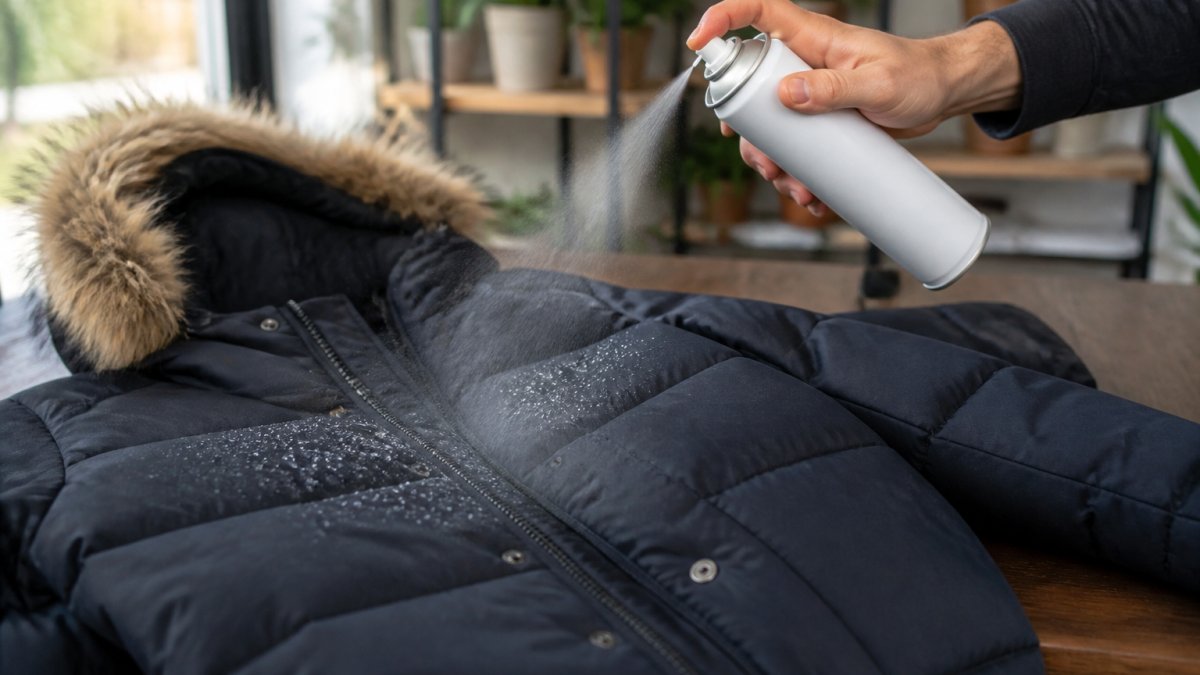
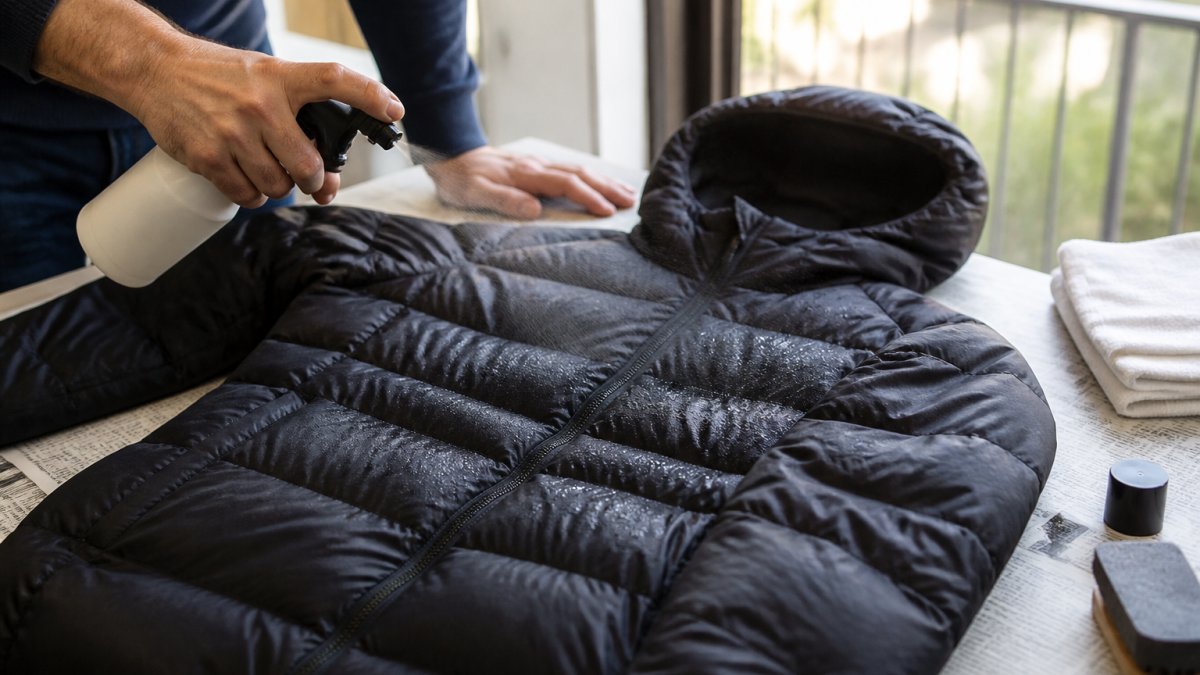
Spray in light, overlapping passes over the shoulders, back, front panels, sleeves, and collar.
Pay special attention to seams, cuffs, and collar edges. These areas take the most water exposure. A slightly heavier application here is acceptable.
Let the coat dry completely before wearing it, most sprays need 24 hours.
After drying, test the repellency. Sprinkle water on treated areas; it should bead and roll off.
Waterproof Spray for Down Jackets: Special Considerations
Down insulation is vulnerable to water: once wet, it clumps and loses all insulating power.
Spray-on treatments are gentler on down jackets than wash-in treatments.
Check whether your down jacket has a DWR (durable water repellency) coating already. Most quality down jackets ship with a factory DWR finish.
Apply spray-on waterproofing to down jackets in a well-ventilated space. The fumes are stronger than you'd experience indoors, and down jackets have a lot of surface area to treat.
Avoid heat sources while the spray dries. Don't hang the jacket near a radiator, vent, or in direct sunlight.
Waterproofing Spray for Breathable Fabrics Without Damage
Breathable fabrics like Gore-Tex, SympaTex, and eVent are engineered to let sweat vapor escape while blocking liquid water.
The key is choosing a spray specifically designed for breathable membranes.
Always test on a hidden area first. Spray a small section on the inside of the hem or a back seam.
Apply lighter coats to breathable fabrics than to standard cotton or synthetic shells. These membranes are thinner and more sensitive to over-saturation.
Most breathable fabrics already ship with a factory DWR coating. Before you spray anything, test the existing coating. Sprinkle water on the shell.
How Long Does Waterproof Spray Last on Winter Coats
The durability of waterproof spray depends on how often you wear the coat and what conditions you expose it to.
Most spray-on treatments last 6-12 months with regular wear.
You'll know the treatment is wearing out when water stops beading up on the fabric and starts soaking in.
Reapplying spray is simple and fast. Most people retreat their coats once a year in fall, before the rainy season hits.
Storing your coat properly extends the life of the waterproof treatment. Keep it in a cool, dry place during off-season.
Waterproofing vs. Water Repellency: What Your Coat Actually Needs
These terms are often used interchangeably, but they mean different things, and that difference matters when you're choosing a spray.
Water repellency means water beads up and rolls off the surface.
Waterproofing means water cannot penetrate the fabric at all, even under pressure. Fully waterproof fabrics are usually plastic-like and don't breathe.
For winter coats, water repellency is what you actually want.
When you're shopping for a spray, look for products labeled "water repellent" or "DWR" (durable water repellency).
The DWR coating on your coat gradually wears away with wear and washing. Reapplying a water-repellent spray restores that protective layer.
Professional Waterproofing Services for High-Value Coats
Professional waterproofing also includes cleaning before treatment. Dirt and body oils reduce the effectiveness of any waterproofing spray.
How Professional Wash Fold Protects Your Clothes explains how professional laundry services care for delicate garments during washing and drying. For winter coats, that care extends to waterproofing.
For residents in Miami, professional services are particularly valuable because the warm, humid climate accelerates moisture damage.
What to Look for in a Professional Laundry Service covers the criteria for choosing a quality provider.
Winter coats are an investment, and protecting that investment means keeping them dry and well-maintained.
CDC guidance on proper fabric care and moisture management
American Cleaning Institute standards for fabric treatment
Textile care label standards from the Federal Trade Commission
Frequently Asked Questions
Do waterproof sprays really work on winter coats?
Yes, waterproof sprays are effective at restoring or adding water repellency to winter coats when applied correctly. They work best on technical fabrics with intact face fibers. Effectiveness depends on the spray type, application method, and coat condition. Spray-on treatments are particularly useful for insulated or thickly lined coats because they allow targeted application without affecting the coat's insulation properties.
Can you use waterproof spray on down jackets?
You can use waterproof spray on down jackets, but you must choose a product specifically safe for down or synthetic insulation. Avoid sprays that clog pores or trap moisture, as this reduces the jacket's warmth and breathability. Always check the product label and test on a hidden area first. Many down jacket manufacturers recommend spray-on treatments over wash-in options because sprays preserve loft and insulation integrity.
How long does waterproof spray last on a winter coat?
Waterproof spray typically lasts 1 to 3 seasons of regular use, depending on the product, how often you wear the coat, and weather exposure. Heavy rain, frequent washing, and friction from backpack straps or body contact accelerate wear. Most users reapply waterproof spray annually or when they notice water no longer beads on the fabric surface.
What is the difference between waterproofing spray and water-repellent spray?
Waterproofing spray creates a barrier that prevents water penetration, while water-repellent spray (or DWR treatment) causes water to bead and run off without fully blocking moisture. Water-repellent sprays are lighter and maintain breathability better, making them ideal for most winter coats. Waterproofing sprays are heavier and better for fully sealed or technical membranes. Most winter coats benefit from water-repellent spray rather than full waterproofing.
Should you wash a winter coat before waterproofing it?
Yes, washing your winter coat before applying waterproof spray removes dirt, oils, and residue that block the spray from bonding to the fabric. Use a gentle wash cycle with cold water and mild detergent, then dry completely before spraying. A clean coat ensures the waterproof treatment adheres evenly and performs at its best. Always check the care label for fabric-specific washing instructions before proceeding.