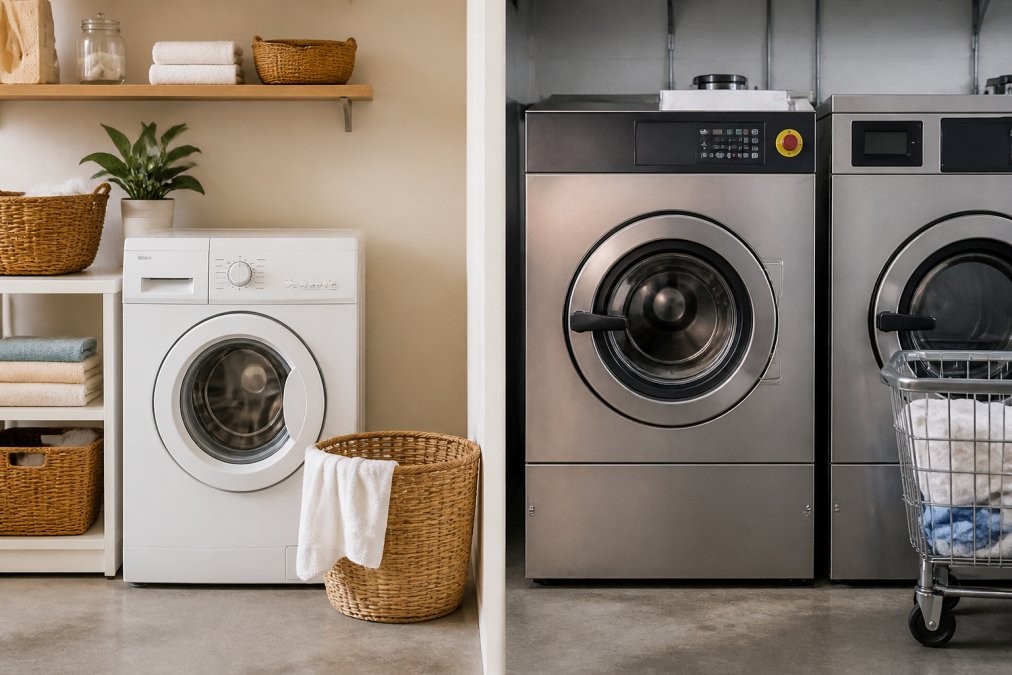
 comparison
Commercial vs Residential Laundry for Small Businesses
Table of Contents
- Commercial vs Residential Laundry: Key Differences at a Glance
- Commercial Washer Capacity vs Residential: What Size You Actually Need
- Durability and Build Quality: How Long Each Type Lasts
- Cost of Commercial vs Residential Washers: Upfront and Long-Term
- Commercial Laundry Machine Warranty Requirements and Protection
- Which Option Wins for Small Business Operations
- Frequently Asked Questions
Last Updated: August 11, 2026
Commercial vs Residential Laundry: Key Differences at a Glance
When small business owners face the choice between commercial-grade and residential-grade laundry equipment, they're really asking: which investment protects my bottom line? The answer matters because this decision shapes your utility bills, maintenance costs, and operational reliability for years.
Commercial-grade machines are built for constant use, designed to handle dozens of loads daily with heavy-duty components like reinforced stainless steel drums, industrial-strength motors, and advanced suspension systems. Residential-grade machines, by contrast, are engineered for typical household use, 5-10 loads per week, with lighter-duty parts that wear faster under commercial demands.
At LaundrPro, we work with busy individuals and families in Miami who need reliable, time-saving laundry and dry cleaning services. The distinction isn't just about durability; it's about total cost of ownership, warranty coverage, and whether your equipment will actually survive the workload you're putting it through.
Here's what separates them: commercial laundry solutions feature higher load capacity (often 4-5 times larger), dramatically faster cycle times, superior extraction speeds that reduce drying costs, and warranty coverage designed for heavy-duty use. Residential machines offer lower upfront costs and simpler operation, but they break down faster under commercial-level demand and often void warranties when used beyond household frequency.
The key question isn't "which is better", it's "which matches your actual workload?" A small laundry service, hotel, or multi-unit property needs commercial equipment. A small retail shop handling employee uniforms might stretch residential equipment if volume stays moderate. Get this wrong, and you're either overspending on capacity you don't need or replacing equipment every 18 months.
Commercial Washer Capacity vs Residential: What Size You Actually Need
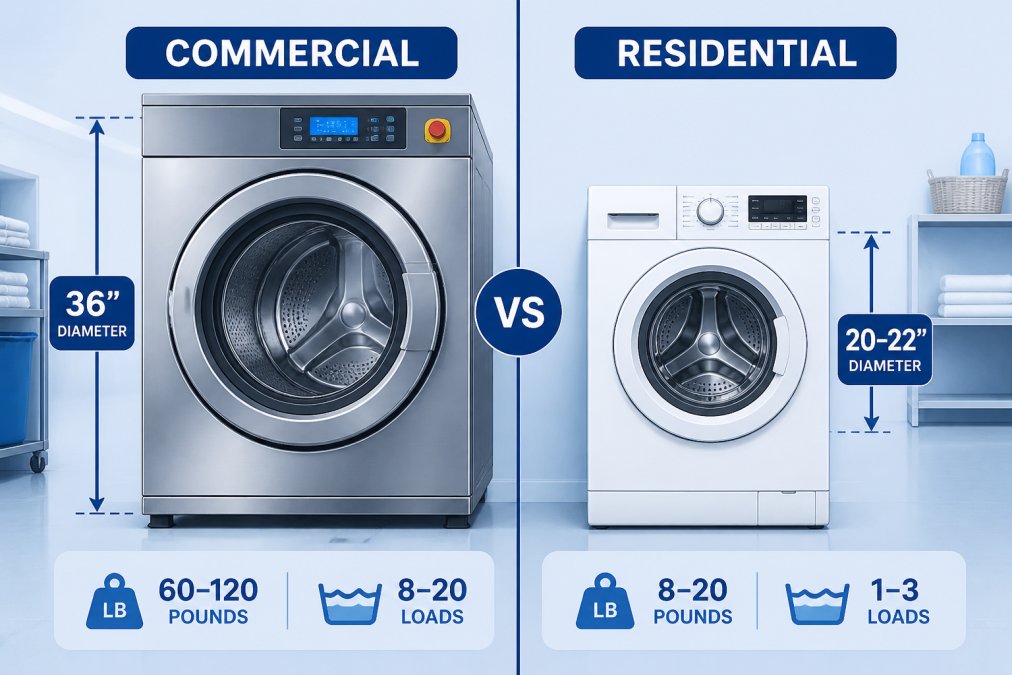
A commercial washer typically handles 30-50+ pounds per load, while residential machines max out around 4-5 pounds. That's not a minor difference, it's the difference between washing one comforter in a commercial machine versus needing three separate residential loads.
For small business operations, capacity directly impacts labor and time. If you're processing 200 pounds of laundry daily, a residential machine forces you into 40-50 individual loads. A commercial machine handles that in 5-8 loads. The labor savings alone can justify the equipment investment within months.
Load capacity also affects cycle time efficiency. Commercial machines are engineered to move water and extract moisture faster at higher volumes. Residential machines slow down proportionally as you approach their capacity limits, they're designed for smaller batches. When you're running a business, that inefficiency compounds across every single day.
Consider water consumption too. Residential machines use 25-40 gallons per cycle regardless of load size. Commercial machines adjust water levels based on actual load weight, which means you're not wasting water on undersized loads. For businesses running 20+ cycles daily, that efficiency gap translates to measurable utility cost reduction.
The cubic feet specification matters more than most people realize. A commercial washer offering 3.19 cubic feet capacity handles roughly 30 pounds of dry weight. Residential machines typically offer 4-5 cubic feet but can't actually process that volume effectively under commercial-duty conditions because the motor, pump, and suspension system weren't designed for sustained heavy loads.
Small business owners often ask: "Can I just buy a larger residential machine?" The answer is no. Oversizing a residential machine doesn't create commercial-grade performance, it accelerates wear on components designed for lighter duty. You'll see increased vibration, mechanical stress, and premature failure.
Durability and Build Quality: How Long Each Type Lasts
Commercial-grade machines are engineered for 10,000+ cycles before major component failure. Residential machines typically fail between 1,500-3,000 cycles. That's not a marketing claim, that's the engineering reality built into motor torque, bearing quality, and frame construction.
The stainless steel drum in a commercial washer is thicker, welded differently, and treated to resist corrosion from constant water exposure. Residential drums are lighter gauge and rely on protective coatings that wear away faster under heavy-duty use. When you're running 20+ loads daily, that coating deteriorates in months, not years.
Motor design separates the two categories fundamentally. Commercial motors use heavy-duty bearings, reinforced shafts, and advanced suspension systems that dampen vibration. Residential motors are simpler, lighter, and fail faster when pushed beyond their design specifications. A commercial motor might cost 3-4 times more upfront, but it outlasts five residential motors.
Mechanical wear patterns tell the story. Commercial machines distribute stress across multiple components through superior engineering. Residential machines concentrate wear on specific parts, typically the drive system, bearings, and suspension. This is why residential equipment under commercial use doesn't just fail once; it fails repeatedly across different systems.
Warranty implications matter here. Most residential warranties explicitly exclude commercial use or limit coverage to 1-2 years. Commercial machine warranties often cover 5-10 years on major components because the manufacturers expect them to last. If your residential washer fails under commercial duty and you file a claim, the manufacturer can deny coverage based on usage exceeding household specifications.
Real-world durability also depends on maintenance. Commercial machines are designed for scheduled preventive maintenance, bearing replacement, seal inspection, suspension adjustment. Residential machines have fewer serviceable parts and less accessible components. When something breaks on a commercial machine, you can often replace just that component. Residential machines frequently require full-unit replacement because parts aren't designed for individual servicing.
The vibration control difference is subtle but critical. Commercial machines use advanced suspension systems that keep vibration minimal even at high extraction speeds. Residential machines vibrate noticeably during spin cycles, which accelerates wear on surrounding plumbing, flooring, and adjacent equipment. Over time, this vibration damage adds to your total cost of ownership.
Cost of Commercial vs Residential Washers: Upfront and Long-Term
Residential washers start around $400-800 for basic models. Commercial machines begin around $1,400-2,000 for entry-level commercial-grade equipment. That upfront gap feels significant until you calculate total cost of ownership.
Here's where the math gets interesting: a residential machine under commercial use typically needs replacement every 18-24 months. A commercial machine lasts 7-10 years. If you're replacing residential equipment every two years at $600 per unit, you're spending $3,000-3,600 per machine over a decade. A commercial machine costing $1,800 upfront spreads that investment across 10 years, roughly $180 annually in equipment cost.
But upfront cost isn't the full picture. Operating costs matter more for small businesses. Residential machines consume 25-40 gallons per cycle. Commercial machines, with better engineering, often use 10-15 gallons per cycle through improved water recirculation and extraction efficiency. At 20 cycles daily, that's a difference of 300-500 gallons daily, roughly 2,000-3,500 gallons weekly. Water costs vary regionally, but for most small businesses, that efficiency gap saves $50-150 monthly.
Energy consumption follows a similar pattern. Residential machines use standard motors that draw significant amperage. Commercial machines use more efficient motors and better-designed pump systems. The extraction speed difference is crucial, commercial machines extract moisture faster, reducing drying time by 20-30%. If you're using dryers, that's direct energy savings.
Repair costs create the biggest long-term gap. Residential machines, when they fail under commercial use, often require full replacement because parts aren't stocked and labor costs exceed repair value. Commercial machines have readily available parts, trained service technicians, and repair costs that typically run 30-40% of replacement cost. A residential machine repair might cost $400-600 but still fail again within months. A commercial machine repair might cost $800-1200 but extends equipment life by years.

Downtime cost is often overlooked. When a residential machine fails during business hours, you're losing revenue while waiting for repair or replacement. Commercial machines have faster repair turnaround because parts are stocked and technicians are trained. That 4-hour difference in downtime can cost a small business hundreds of dollars.
Financing also differs. Most commercial equipment qualifies for business financing or lease programs. Residential machines don't. If you're a small business, financing a commercial machine might actually be cheaper monthly than buying residential equipment outright and replacing it repeatedly.
Commercial Laundry Machine Warranty Requirements and Protection
Warranty coverage is where commercial vs residential laundry decisions reveal their true cost implications. Most residential warranties cover 1-2 years and explicitly exclude commercial use. Read the fine print and you'll find language like "intended for household use only" or "limited to 5-8 loads per week." Use the machine commercially and the warranty is void.
Commercial machine warranties typically span 5-10 years on major components, motor, drum, pump, control board. Some manufacturers offer 3-year full coverage and 7-year coverage on specific components. The difference isn't just longer protection; it's recognition that commercial equipment is expected to last longer and operate under different conditions.
Warranty voidance is a real risk for small business owners. If you buy a residential machine for commercial use and it fails, the manufacturer can deny your claim. You'll have no recourse except full replacement cost. This is why some small businesses that started with residential equipment learned the hard way, they had a $600 machine fail and discovered the warranty didn't cover their usage pattern.
Commercial warranties often include scheduled maintenance coverage. The manufacturer expects you to perform bearing inspections, seal replacements, and suspension adjustments at specific intervals. This isn't a burden, it's built into the warranty structure because proper maintenance extends equipment life. Residential warranties assume you'll just use the machine and never service it.
Some commercial machines offer extended warranty options that cover parts and labor for 10+ years. These programs cost more upfront but eliminate uncertainty. For a small business, knowing your equipment is covered for a decade makes financial planning easier and removes the risk of catastrophic failure.
Compliance and safety standards also matter. Commercial machines must meet industrial standards for vibration, noise, and electrical safety. Residential machines meet household standards, which are less stringent. If your business operates in a space with noise restrictions or if you're stacking machines, commercial equipment's engineered stability matters for both safety and regulatory compliance.
The warranty difference extends to parts availability. Commercial machine manufacturers stock parts for 10-15 years after production ends. Residential manufacturers often discontinue parts after 3-5 years. If your commercial machine needs a bearing replacement in year 8, the part is available. If your residential machine needs the same repair in year 4, you might find the part is discontinued and replacement is your only option.
Which Option Wins for Small Business Operations
For small businesses processing 50+ pounds of laundry daily, commercial-grade equipment is the clear winner. The durability advantage, warranty protection, and operational efficiency justify the higher upfront cost within 12-18 months of operation.
If your business processes 20-50 pounds daily and can commit to careful maintenance, commercial equipment still makes financial sense. The total cost of ownership, accounting for replacement cycles, repair costs, and utility savings, favors commercial machines.
For businesses processing under 20 pounds daily, residential equipment might survive if you're selective about load sizes and maintenance. But understand the risks: your warranty is likely void, repairs will be expensive, and you're one major failure away from full replacement. Many small business owners in this category choose commercial equipment anyway because the peace of mind is worth the investment.
The decision also depends on your laundry type. Delicate garments, specialty fabrics, and mixed loads require precise cycle control that commercial machines provide. High-volume standard laundry, uniforms, towels, linens, can work with either type if volume stays moderate. But once you exceed 30-40 loads weekly, residential equipment becomes unreliable.
Consider also your growth trajectory. If you're a startup expecting to scale, commercial equipment is the right choice even if current volume doesn't demand it. Upgrading later means disposing of the residential machine and buying new equipment. Starting with commercial equipment means your infrastructure grows with your business.
LaundrPro helps busy individuals and families in Miami by providing professional laundry services that eliminate the equipment question entirely. Our door-to-door pickup and delivery service handles all the durability concerns, maintenance requirements, and warranty complexities. For many, outsourcing laundry to a professional service costs less than owning equipment and eliminates operational headaches.
The real cost of commercial vs residential laundry isn't just the purchase price, it's the total impact on your business operations, cash flow, and reliability. Commercial equipment wins for businesses committed to handling laundry in-house at volume. Professional services like LaundrPro win for businesses that want to focus on their core operations while ensuring spotless results and fast turnaround without equipment investment.
Small business owners often underestimate how much laundry operations impact their bottom line. Whether you choose commercial equipment or outsource to a professional service, the key is matching your solution to your actual volume and reliability requirements. If you're managing high-volume laundry in-house, commercial-grade equipment is the only sensible long-term investment. If you're looking to eliminate equipment costs and operational complexity entirely, professional laundry services provide spotless results with transparent, flat-rate pricing and no hidden fees. LaundrPro offers door-to-door pickup and delivery with fast turnaround, so you can focus on running your business while we handle the laundry.
Frequently Asked Questions
Is a commercial washer better than a residential washer for small businesses?
It depends on your volume and budget. Commercial washers handle heavy-duty usage with larger load capacities, longer machine lifespan, and better durability under continuous operation. Residential washers cost less upfront but wear out faster with frequent use and have lower load capacity. For small businesses processing laundry regularly, commercial-grade equipment typically delivers better total cost of ownership despite higher initial investment.
What are the key differences between commercial laundry machine warranty requirements?
Commercial washers typically come with longer warranty coverage on major components (often 5-10 years), reflecting their heavy-duty design. Residential warranties usually last 1-3 years. Commercial warranties often include parts and labor, while residential warranties may exclude labor. Additionally, commercial warranties require proper maintenance schedules and professional servicing to remain valid, whereas residential machines have fewer restrictions. Voiding is a real risk if you use commercial equipment for business without proper coverage.
How much capacity difference exists between commercial and residential washers?
Residential washers typically handle 4-5 cubic feet of laundry per load, while commercial-grade machines range from 3.19 to 9+ cubic feet depending on the model. A commercial washer's larger capacity means fewer cycles needed to process the same volume, reducing cycle time and labor hours. For small businesses handling multiple loads daily, this capacity advantage translates to significant operational efficiency and faster throughput.
Can I legally use a residential washer for my small business laundry?
Technically yes, but it's not recommended and creates warranty and liability issues. Using residential equipment for commercial purposes typically voids the manufacturer's warranty, leaving you unprotected if the machine fails. Additionally, residential washers aren't engineered for the mechanical wear of commercial use, they'll require more frequent repair and replacement. From a compliance standpoint, many commercial laundry facilities and insurance policies expect commercial-grade equipment for business operations.
This article was written using GrandRanker