 listicle
Benefits of Flat Rate Laundry Pricing
Table of Contents
- What Is Flat Rate Laundry Pricing?
- How Flat Rate Pricing Compares to Per-Pound and Hourly Models
- Understanding Average Cost of Wash and Fold Service
- Key Benefits for Service Providers
- Why Customers Prefer Flat Rate Pricing: Cost Predictability and Transparency
- Laundry Service Subscription Benefits vs. Per-Load Flat Rates
- How to Calculate Per Pound Laundry Cost and Set Competitive Flat Rates
- Psychological Pricing Impact and Customer Retention
- Frequently Asked Questions
Last Updated: August 15, 2026
What Is Flat Rate Laundry Pricing?
Flat rate laundry pricing is a service model where customers pay a fixed, predetermined price for laundry services regardless of weight, item count, or complexity. Instead of charging per pound or by the hour, service providers establish one transparent price that covers the entire wash, dry, and fold process. This eliminates guesswork about final costs and creates predictability for both the business and its customers.
At LaundrPro, we've built our entire service model around transparent, flat-rate pricing. This commitment to clarity means busy professionals and families in the area can focus on what matters most while knowing their laundry costs won't fluctuate based on load size or garment type.
How Flat Rate Pricing Compares to Per-Pound and Hourly Models
Understanding how flat rate pricing stacks up against alternative billing methods helps service providers and customers make informed decisions about which model fits their needs.
Per-pound pricing charges customers based on the weight of their laundry load. A 10-pound bag costs less than a 20-pound bag. This creates unpredictability for customers who can't always estimate their load weight accurately. A customer might think they're paying $30 and end up with a $45 bill. Per-pound models also incentivize providers to rush through work to maximize throughput, compromising quality.
Hourly rate models bill customers for the time spent on their laundry. Hourly pricing rewards thoroughness, but it creates anxiety for customers who worry about labor costs spiraling. Service providers face pressure to work faster to maintain profitability, conflicting with quality.
Flat rate laundry pricing eliminates these tensions. The customer pays one price. The service provider has predictable revenue per order. Both parties can focus on quality rather than speed or weight calculations.
| Pricing Model | Customer Predictability | Provider Efficiency | Quality Incentive | Complexity |
|---|---|---|---|---|
| Per-Pound | Low (weight varies) | High (volume-driven) | Medium | Low |
| Hourly Rate | Low (time varies) | Medium (quality-driven) | High | Medium |
| Flat Rate | High (fixed price) | High (consistent margins) | High | Medium |
The flat rate model particularly benefits service providers who want to build a sustainable business around quality rather than speed. It also appeals to customers who value transparency and hate surprises on their invoice.
Understanding Average Cost of Wash and Fold Service
The average cost of wash and fold service varies significantly based on geography, service complexity, and delivery options. In most markets, wash and fold services operate within a range that reflects local labor costs, overhead, and competitive positioning.
Many wash and fold services structure their pricing around bag size or weight. A small delicates bag might cost less than a standard laundry bag, which costs less than a bulky items bag. This tiered approach allows customers to choose a service level that matches their actual needs. Some services offer free delivery for standard turnaround times and charge premiums for rush service or next-day delivery.
The real cost of wash and fold includes more than just labor. Providers must account for water, detergent, electricity, equipment maintenance, insurance, and vehicle costs for pickup and delivery. These overhead expenses don't change much whether a customer sends in a 5-pound load or a 20-pound load. This reality makes flat rate pricing particularly sensible for wash and fold operations, as it spreads fixed costs across all orders rather than penalizing customers with larger loads.
When evaluating pricing in your market, research what established competitors charge and what local labor costs support. A service in a high-cost urban area will necessarily charge more than one in a lower-cost region. The key is ensuring your pricing covers your actual costs while remaining competitive.

Key Benefits for Service Providers
Adopting flat rate laundry pricing offers substantial operational and financial advantages for service businesses. The model creates stability that allows providers to plan, invest, and scale more effectively than variable pricing alternatives.
Revenue Predictability becomes the foundation of sound business planning. When you know each order generates a consistent revenue amount, forecasting becomes straightforward. You can predict monthly income, plan staffing levels, and make equipment investments with confidence.
Reduced Administrative Burden is a practical benefit that compounds over time. No weighing loads to determine final charges. No disputes about whether that delicate sweater qualified for premium pricing. Your staff spends less time on billing disputes and more time on service delivery, directly improving profit margins.
Improved Profit Margins follow naturally when you eliminate waste in the billing process. You gain flexibility in how you allocate labor. A customer pays the same whether you spend 45 minutes or 60 minutes on their load. This encourages you to invest in proper care, hand-washing delicates, and treating stains carefully, without worrying that extra time cuts into your margin.
Customer Retention strengthens when customers experience transparent pricing and consistent quality. Repeat customers are more valuable than constantly acquiring new ones. Flat rate pricing builds trust because there are no surprises. Customers recommend your service to friends and family more readily when they know exactly what to expect.
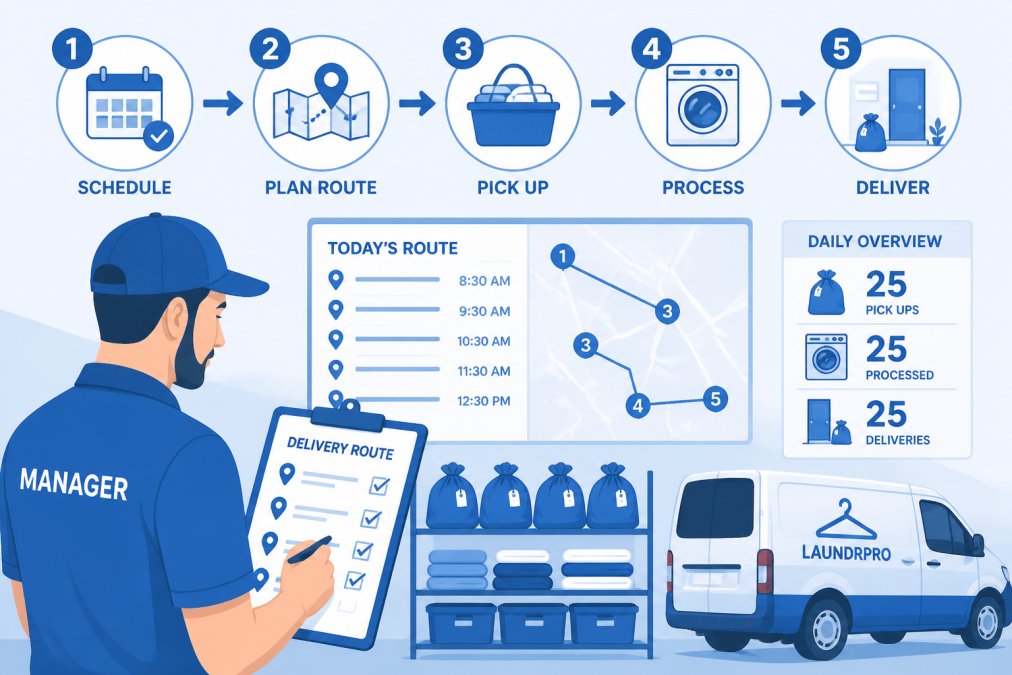
Operational Efficiency improves when you structure your work around consistent order sizes. You can optimize your washing cycles, drying times, and folding workflows for a standard load. You know how many loads your equipment can handle per day and can schedule staff more effectively.
Competitive Positioning becomes stronger when you can emphasize transparency and predictability. Many customers are frustrated by surprise charges and complex pricing structures. A clear, honest flat rate model differentiates you in a crowded market.
Why Customers Prefer Flat Rate Pricing: Cost Predictability and Transparency
From the customer perspective, flat rate laundry pricing solves a real pain point: the anxiety of not knowing what you'll pay until the bill arrives.
Budget Control becomes possible when customers know the exact cost upfront. A busy professional or parent can include laundry service costs in their monthly budget with precision. There's no risk of unexpected charges that blow through discretionary spending.
Transparency Builds Trust in ways that complex pricing structures cannot. When a customer sees a simple, honest price with no hidden fees, they believe you're being straightforward about your business. This trust translates into loyalty and positive word-of-mouth recommendations.
Elimination of Surprises removes one of the biggest frustrations with service pricing. A customer who sends in a load expecting to pay $35 and receives a $52 bill because their laundry weighed more than expected feels deceived. Flat rate pricing eliminates this scenario entirely.
Simplified Decision-Making appeals to time-pressed customers. Instead of calculating whether a 15-pound load is worth $40 or whether rush delivery justifies the extra cost, the customer sees one clear option. This simplicity reduces friction in the purchasing decision.
Fairness Perception matters more than most businesses realize. Customers feel that per-pound pricing penalizes them for having larger loads. Flat rate pricing feels fairer because everyone pays the same. This perception of fairness increases satisfaction regardless of the actual cost.
Laundry Service Subscription Benefits vs. Per-Load Flat Rates
Many laundry service providers now offer subscription models where customers pay a recurring fee for a set number of loads per month. Understanding how subscriptions compare to per-load flat rates helps customers choose the right model for their situation.
Subscription Models typically offer a lower per-load cost in exchange for commitment. A customer might pay $99 per month for four loads, which works out to $24.75 per load. This pricing rewards loyalty and creates predictable monthly revenue for the provider. Subscriptions work well for customers with consistent laundry volumes who want the lowest possible per-load price.
The downside of subscriptions emerges when customer needs fluctuate. A month with fewer loads wastes the unused portion. A month with more loads requires paying additional per-load charges. Subscriptions also create friction when customers want to cancel or pause service.
Per-Load Flat Rates offer flexibility without commitment. A customer pays the same price whether they use the service once per month or four times. There's no penalty for light usage and no surprise charges for heavy usage. This model appeals to customers whose laundry needs vary seasonally or unpredictably.
Per-load flat rates also simplify the customer experience. There's no subscription management, no worry about unused credits, no cancellation hassles. The customer simply places an order when they need service and pays the agreed price.
LaundrPro's commitment to flat-rate pricing without subscriptions aligns with this preference for transparency and flexibility. Customers choose service when they need it, knowing exactly what they'll pay, without any ongoing commitment or unused monthly credits.
How to Calculate Per Pound Laundry Cost and Set Competitive Flat Rates
For service providers considering a transition to flat rate pricing, understanding how to calculate sustainable pricing requires examining your actual costs and market conditions.
Start with Your Cost Structure. Calculate your total monthly operating expenses: labor, utilities, detergent and chemicals, equipment maintenance, vehicle costs for pickup and delivery, insurance, and facility rent. Divide this by your estimated monthly load volume to determine your cost per load. This is your baseline; you cannot price below this without losing money.
If your monthly costs total $12,000 and you process 400 loads per month, your cost per load is $30. Your flat rate must exceed this to generate profit. A $45 flat rate leaves $15 margin per load, or $6,000 monthly profit at full capacity.
Research Local Market Rates. What are established competitors charging? What does the local market support? A service in a high-income urban area can command higher rates than one in a lower-income region. Pricing significantly above local market rates reduces volume. Pricing significantly below makes profitability difficult.
Consider Your Service Level. Premium services with faster turnaround, specialized care for delicates, or additional amenities justify higher pricing. Standard services with longer turnaround times can price lower. Your flat rate should reflect the service quality and speed you're delivering.
Test and Adjust. Launch with your calculated rate and monitor results. If you're at full capacity and have a waiting list, you're likely underpriced. Raise rates incrementally. If you're struggling to book orders, you may be overpriced or your marketing needs improvement.
Build in Flexibility. Consider offering tiered flat rates for different service levels. A standard load might cost $40. A rush load with 24-hour turnaround might cost $55. Bulky items like comforters might cost $50. This approach maintains the transparency of flat rate pricing while capturing additional value for premium services.
The goal is setting a rate that covers your costs, generates reasonable profit, remains competitive in your market, and feels fair to customers.
Psychological Pricing Impact and Customer Retention
Beyond the operational benefits, flat rate pricing influences customer psychology in ways that directly affect retention and lifetime value.
Price Anchoring occurs when customers remember the first price they see and use it as a reference point for all future pricing decisions. When you establish a clear, transparent flat rate, that becomes the customer's anchor. Subsequent orders feel consistent and fair because they match the initial expectation.
Loss Aversion describes how people feel the pain of losing money more intensely than the pleasure of gaining equivalent value. A customer charged an unexpected $20 more than anticipated feels significant loss and resentment. A customer who knows the price upfront and pays it feels no loss; they made an informed decision. This psychological difference drives retention.
Perceived Value increases when pricing feels transparent and fair. Customers who understand what they're paying for and why feel they're getting good value, even at relatively high prices. Flat rate pricing creates clarity that enhances perceived value.
Switching Costs become psychological as well as practical. A customer satisfied with transparent, predictable pricing from one provider faces friction switching to a competitor with complex pricing structures. This psychological switching cost increases retention even if a competitor offers slightly lower prices.
Loyalty Programs become more effective when built on flat rate foundations. You can offer loyalty discounts ("Fifth load free") without creating pricing confusion. Customers understand the base price and understand the bonus.
The intersection of operational efficiency and psychological customer satisfaction makes flat rate pricing a powerful competitive advantage. Service providers who embrace this model build stronger customer relationships and more sustainable businesses than those relying on variable pricing complexity.
Choosing the right pricing model shapes your entire business. Flat rate laundry pricing delivers operational clarity for your team, budget predictability for your customers, and psychological satisfaction that drives retention. If you're managing laundry operations and struggling with billing complexity or customer disputes over pricing, consider how flat rates could simplify your business while improving customer loyalty. LaundrPro's transparent, flat-rate approach demonstrates how this model works in practice, delivering spotless results with fast turnaround and honest pricing that customers understand and appreciate. Ready to experience the difference transparent pricing makes? Place your order with LaundrPro and discover why busy professionals and families choose clarity over complexity.
Frequently Asked Questions
How does flat rate laundry pricing work compared to per-pound models?
Flat rate laundry pricing charges a fixed fee regardless of weight, while per-pound pricing scales with load size. Flat rates eliminate weight-based surprises and offer billing transparency, making budgeting easier for customers. Per-pound models may be cheaper for light loads but unpredictable for larger families. Flat rates simplify billing cycles and improve financial forecasting for service providers, though they require careful calculation of labor costs and overhead expenses to maintain profitability.
What are the main benefits of flat rate laundry pricing for consumers?
Flat rate pricing delivers cost predictability, customers know exactly what they'll pay before placing an order. This eliminates billing surprises and allows families to budget reliably. Transparency builds trust, especially versus subscription models with hidden fees. For busy professionals and families with high volumes, flat rates provide value-based pricing that rewards consistent service use. The straightforward model also reduces friction in the purchasing decision, improving conversion rates compared to complex per-pound or hourly alternatives.
Is paying for a flat rate laundry service worth the investment?
For busy professionals and families, flat rate laundry services reclaim valuable time, often 5-10 hours per week. The service value extends beyond the price: fast turnaround (24-48 hours), expert care for delicate items, and premium product care prevent damage to expensive garments. Flat rates offer better value than per-pound services for consistent, high-volume users, and they eliminate the uncertainty of subscription apps. Whether it's worth it depends on your time value and laundry volume, but transparent, flat-rate pricing removes the financial risk from trying a service.
How do laundry services calculate flat rate fees?
Flat rate pricing is calculated by analyzing labor costs, overhead expenses, pickup and delivery costs, and desired profit margin. Service providers estimate average load weight, turnaround time, and service complexity, then set a rate that covers these factors consistently. For example, a service might calculate hourly labor ($20/hour × 0.5 hours per load) plus delivery costs ($5) plus overhead allocation ($3) plus profit margin (25%), yielding a $20 flat rate. Rates vary by service area, scope of work, and whether bulk items like comforters are included, but the goal is a standardized fee that maintains profitability across all orders.
This article was written using GrandRanker